Bailibo Testing--Piezoelectric film hysteresis loop test analysis
Technical News
As a ferroelectric functional material, the hysteresis loop (P-E curve) of piezoelectric films is the core basis for characterizing ferroelectric and piezoelectric properties. It can intuitively reflect the nonlinear correlation and hysteresis characteristics of polarization intensity and external electric field, and provides key parameter support for material mechanism research, process optimization and device design. Bailibo Testing's piezoelectric film hysteresis loop test covers the four core modes of normal temperature/variable temperature, full wave/half wave, and adapts to the performance characterization needs in different scenarios.
The core principle of hysteresis loop testing originates from the spontaneous polarization characteristics of ferroelectric materials. There are a large number of tiny electric domains inside the piezoelectric film. When there is no external field, the electric domains are arranged in disorder, and the macroscopic polarization intensity is zero. After an alternating electric field is applied, the electric domains are oriented and aligned with the direction of the electric field and the polarization flips, and the polarization intensity changes nonlinearly. When the electric field is reversed, there is a hysteresis effect in the electric domain flipping, and finally a closed P-E loop is formed. This is the core symbol that distinguishes ferroelectric materials from ordinary dielectrics. The mainstream test uses the Sawyer-Tower circuit method, which uses a ferroelectric analyzer and a high-voltage power amplifier to capture the polarization flip current and generate a loop curve in real time.
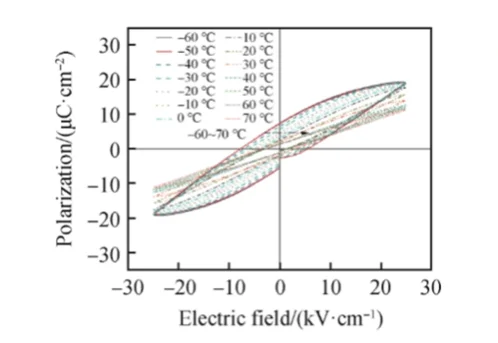
From the test mode, normal temperature P-E (full wave) is the basic characterization mode, which applies a complete positive and negative alternating electric field at room temperature to obtain core parameters such as saturation polarization intensity (Ps), residual polarization intensity (Pr), and coercive electric field (Ec). Ps reflects the maximum polarization ability of the material, Pr reflects the ability to maintain polarization after the electric field is removed, and Ec represents the electric field strength required for electric domain reversal. The three are directly related to the material energy storage density, device stability and driving energy consumption. This mode is suitable for routine performance screening and basic parameter calibration.
The effect of variable temperature P-E (full wave) focusing temperature on polarization characteristics. The electric domain structure and polarization flipping behavior of piezoelectric films are highly sensitive to temperature. An increase in temperature will intensify the thermal movement of the electric domains, causing the loops to become thinner and longer, and Ps, Pr, and Ec all show a downward trend. Through full-wave testing at different temperatures, the ferroelectric phase transition temperature, high-temperature stability and polarization attenuation rules of the material can be clarified, providing data support for material selection and structural design of high-temperature operating devices (such as aerospace sensors, high-temperature drivers).
Normal temperature P-E (half-wave) only applies a unidirectional alternating electric field, focusing on the response characteristics of a single polarization direction. Compared with the full-wave mode, the half-wave mode can avoid reverse polarization interference and accurately characterize the difficulty of unidirectional polarization flipping, leakage conduction characteristics and polarization fatigue behavior of materials. It is suitable for performance evaluation of unidirectional drive devices (such as piezoelectric micropumps and unipolar sensors). It can also simplify data analysis and reduce test errors under complex working conditions.
Variable temperature P-E (half-wave) combines the dual variables of temperature and unidirectional electric field to accurately reveal the regulation mechanism of temperature on the unidirectional polarization characteristics of materials. This mode can simulate the unidirectional electric field-temperature coupling environment in the actual operation of the device, evaluate the unidirectional polarization stability, leakage current changes and failure mechanism of the material under extreme temperatures, and provide key basis for device reliability design in extreme environments.
Piezoelectric film hysteresis loop testing requires strict control of sample preparation and testing conditions. The sample needs to prepare upper and lower electrodes to ensure good contact. During testing, it is immersed in silicone oil to reduce the influence of leakage conduction. Triangular waves are commonly used as test waveforms. The frequency is adjusted according to the characteristics of the film. The voltage needs to be gradually increased until the loop is saturated to avoid high voltage breakdown of the sample. The four test modes complement each other and can comprehensively cover the polarization characteristics of piezoelectric films from normal temperature to high temperature, and from bidirectional to unidirectional, providing systematic and accurate performance data support for basic materials research and engineering applications.
Request High-Precision Testing Solutions
Get expert guidance and customized instruments for your functional materials project.