Bailibo Testing: Analysis of piezoelectric material d33 wide temperature range testing technology
Technical News
The longitudinal piezoelectric coefficient d33 of a piezoelectric material is the core parameter to measure its electromechanical conversion capability. The unit is pC/N, which refers to the charge density generated on the surface of the material under the action of unit longitudinal stress. The d33 value directly determines the performance upper limit of piezoelectric sensors, transducers, actuators and other devices. As a key environmental variable, temperature will significantly affect the material lattice structure and polarization state, thereby changing the d33 characteristics. Therefore, carrying out d33 tests under normal temperature, high temperature, low temperature and variable temperature conditions is crucial to material research and development, process optimization and device reliability design.
Testing principles and core methods
The mainstream d33 test adopts the quasi-static method, which is in line with the GB/T 11309-1989 national standard. The core principle is based on the positive piezoelectric effect: applying a low-frequency alternating force to the sample (much lower than the resonant frequency), measuring the alternating charge generated on the surface, calculated through the formula d33=Q/F (Q is the charge, F is the pressure). This method, combined with lock-in amplification technology, can effectively suppress noise interference, with a test accuracy of less than 1% and a resolution of up to 0.1pC/N. It is suitable for testing various piezoelectric ceramics, single crystals, thin films and polymer materials.
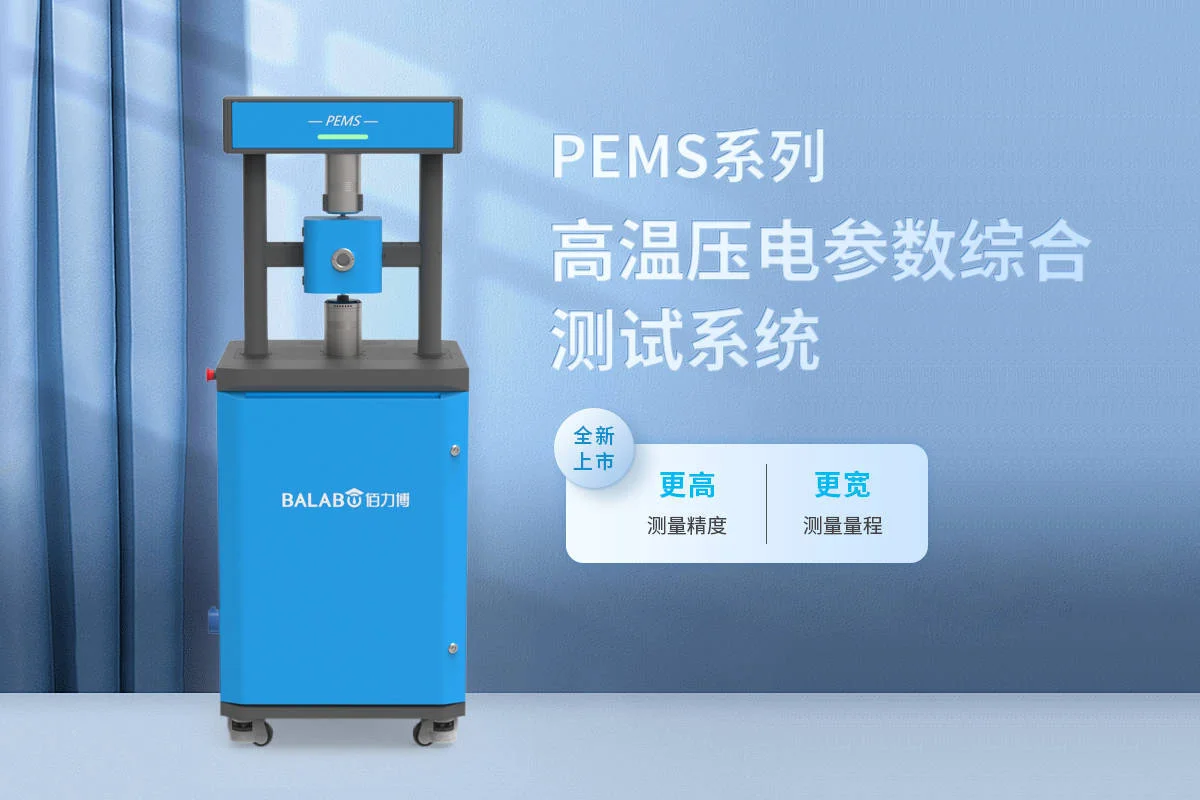
Key points of testing in different temperature ranges
Normal temperature d33 test (around 25°C)
As a basic performance test, it is conducted in a standard laboratory environment to obtain the baseline piezoelectric properties of materials. When testing, it is necessary to ensure that the sample electrodes are uniform and the pressure application direction is consistent with the polarization direction. Commonly used preload force is 10N and alternating force 0.25N. Quick and stable acquisition of basic data is the first step in material screening and quality control.
High temperature d33 test (room temperature to 600℃/800℃)
Simulate the high temperature working conditions of the device, focusing on evaluating the thermal stability and Curie temperature. The test system uses resistance wire to heat the furnace, with precise temperature control and adjustable heating rate. Nitrogen protection is required at high temperatures to prevent electrode oxidation and sample surface modification, and capture the d33 attenuation law and Curie temperature point (performance mutation temperature) in real time to provide a basis for determining the upper limit of the operating temperature.
Low-temperature d33 test (can be customized to -40℃)
For low-temperature environment application scenarios (such as aerospace, polar equipment), test the piezoelectric performance stability of materials at low temperatures. The low-temperature test requires a liquid nitrogen refrigeration module to accurately control the cooling rate, monitor the changing trend of d33 as the temperature decreases, and evaluate the domain structure stability and electromechanical conversion capability retention rate at low temperatures.
Variable temperature d33-T test
Continuously track the entire change of d33 from low temperature to high temperature, automatically generate a d33-T temperature spectrum curve, and intuitively display the dynamic evolution of performance with temperature. This test can comprehensively reveal the thermal reversibility, phase transition temperature and long-term high temperature reliability of the material. It is a core test item for the development of new piezoelectric materials and adaptation of device operating conditions.
Test value and application scenarios
Wide temperature range d33 test data provides quantitative support for material formula optimization and preparation process improvement, helping to improve the performance retention rate of materials under extreme temperatures. At the same time, it provides key parameters for the structural design, life evaluation and application selection of piezoelectric devices, which are widely used in electronics, ultrasound, sensing, aerospace and other fields. It is an important bridge connecting basic research and engineering applications of materials.
Request High-Precision Testing Solutions
Get expert guidance and customized instruments for your functional materials project.