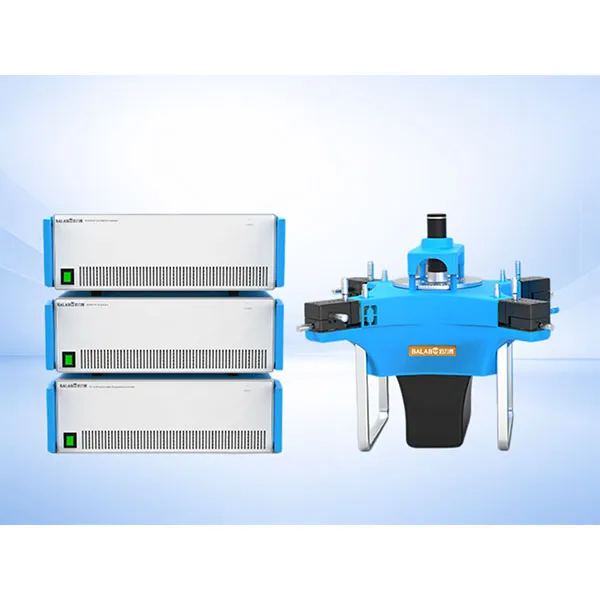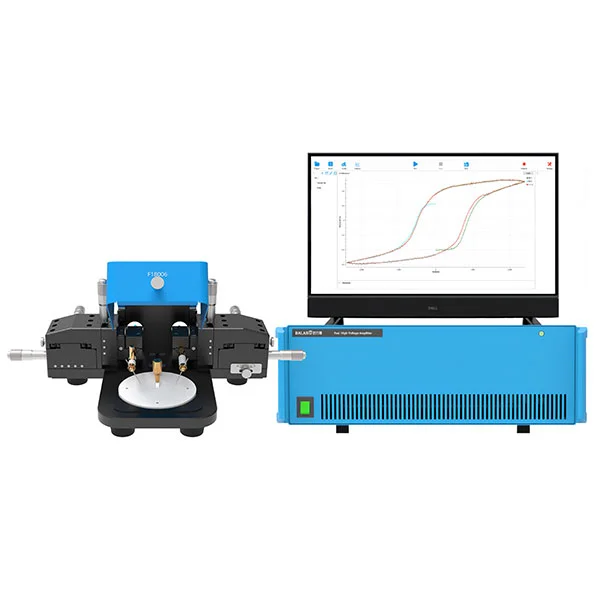
Overview
MatMeas FEAI1000 High-Precision Ferroelectric Analyzer is a dedicated measurement system for evaluating ferroelectric thin films. The instrument features a ±100V high-voltage source capable of measuring P-E hysteresis loops to extract critical parameters including spontaneous polarization (Ps), remnant polarization (Pr), and coercive field (Ec).
With a wide frequency range (0.01Hz to 1kHz) and current measurement from 1nA to 10mA, the FEAI1000 supports comprehensive ferroelectric, leakage, and pulse switching studies.
It is widely adopted by universities, research institutes, and industrial laboratories for advanced dielectric functional ceramic research.
Specifications
| Parameter | Specification |
| Test Voltage Range | ±100 V (Built-in or external high-voltage amplifier) |
| Measurement Frequency | 0.01 Hz ~ 1 kHz |
| Current Measurement Range | 1 nA ~ 10 mA |
| Minimum Pulse Width | 2 μs |
| Minimum Rise Time | 1 μs |
| Maximum Load Capacitance | 1 μF |
| Peak Output Current | 10 mA |
| Sample Type Compatibility | Specifically optimized for Thin Film Materials |
| Power Supply | 220 V / 50/60 Hz |
| Weight | 15 kg |
| Warranty | 1 Year |
Applications
- Ferroelectric Thin Film Research
P-E hysteresis,fatigue and imprint characterization - Dielectric Functional Ceramics
Polarization switching and domain dynamics studies. - Memory Device Development
FeRAM material evaluation and optimization. - Piezoelectric Materials
Coercive field and polarization behavior analysis. - Leakage Current Characterization
Time-dependent dielectric breakdown and conduction mechanisms. - Academic & Industrial R&D
Universities,research institutes,and corporate laboratories
FAQ
What crucial parameters can the FEAI1000 extract from ferroelectric thin films?
The FEAI1000 is highly specialized for thin-film characterization. It accurately measures the P-E hysteresis loop, allowing researchers to effortlessly obtain critical parameters including Spontaneous Polarization (Ps), Remnant Polarization (Pr), Coercive Field (EC), and leakage current dynamics.How does the system handle high-voltage risks and protect the instrument from sample breakdown?
A major pain point with traditional imported analyzers is their vulnerability to sample short-circuits. The FEAI1000 is distinctly engineered with a robust high-voltage breakdown protection module. In the event of a sudden dielectric breakdown, the protection circuit clamps the output voltage within microseconds, preventing catastrophic damage to the internal electrometer and excitation circuits — ensuring that even if a thin-film sample fails during testing, the instrument's core hardware remains fully protected.How does the measurement performance compare to global industry standards like aixACCT or PolyK?
The FEAI1000 is designed to meet the highest global standards. Its measurement accuracy and data fidelity are fully comparable to the German aixACCT TF2000 system. Furthermore, it surpasses models like the PolyK LY20 by offering superior operational stability and significantly more accessible maintenance protocols, making it a highly reliable alternative for top-tier laboratories.Does the FEAI1000 support PUND measurements, and is it built into the software?
Yes. PUND (Positive-Up Negative-Down) measurement is fully integrated into the FEAI1000 software as a standard function — no additional modules or external equipment are required. PUND testing applies a defined pulse sequence to separate true switchable polarization from non-switching contributions (linear dielectric response and leakage), providing a more accurate picture of intrinsic ferroelectric switching behavior, especially for thin-film samples with significant leakage current.What thin-film sample thicknesses and minimum measurable charges does the FEAI1000 support?
The FEAI1000 is optimized for thin-film capacitor samples with active layer thicknesses in the range of 100 nm to 1 μm — the typical range for ferroelectric thin films such as PZT, BaTiO₃, HfO₂-based, and nitride-based systems. The minimum measurable charge is 250 pC, enabling reliable P-E loop acquisition on micro-area capacitors with small electrode dimensions, as commonly encountered in thin-film device research.Can the FEAI1000 be used for high-temperature ferroelectric measurements up to 1000°C?
Yes. When connected to a compatible high-temperature stage or furnace fixture, the FEAI1000 supports ferroelectric characterization from room temperature up to 1000°C. This enables temperature-dependent P-E loop studies, Curie temperature mapping, and phase transition analysis for bulk ceramics and thick-film samples. For thin-film measurements requiring probe contact, the FEAI1000 pairs with the CPS7000 probe station for measurements from -160°C to 450°C.What is the recommended system configuration for complete ferroelectric thin-film characterization?
The recommended configuration for ferroelectric thin-film characterization is the CPS7000 High-Low Temperature Vacuum Probe Station combined with the FEAI1000 Ferroelectric Analyzer and a high-voltage amplifier. The CPS7000 provides the variable-temperature (-160°C to 450°C), vacuum-compatible probing platform, while the FEAI1000 handles P-E loop acquisition, PUND testing, fatigue, and imprint measurements. This integrated system is suitable for characterizing ferroelectric and piezoelectric thin films including nitride-based, oxide-based, and HfO₂-based materials.What are the minimum pulse width and rise time of the FEAI1000, and why does this matter for ferroelectric research?
The FEAI1000 supports a minimum pulse width of 2 μs and a minimum rise time of 1 μs. These specifications are critical for studying fast ferroelectric polarization switching kinetics — particularly for thin-film materials with low coercive fields where slow pulses would introduce thermal heating artifacts and distort the true switching current response. The 2 μs / 1 μs capability also enables reliable PUND and fatigue measurements at elevated pulse frequencies, covering the dynamic switching behavior of next-generation FeRAM and neuromorphic device materials.