Ferroelectric P-E Loop & PUND Pulse Testing Series
Technical Specifications & Test Capabilities
| Parameter / Metric | Specification Range & Accuracy | Operational Notes |
|---|---|---|
| Voltage Drive | Internal: ±100 V; External Amplifier: ±10 kV | High-voltage capability for thick ceramics & polymers |
| Charge Sensitivity | 1 pC to 10 mC | High-speed virtual ground charge integration |
| Temperature Capabilities | Room Temp to 200°C / 450°C; Cryogenic to -150°C | Variable temperature ferroelectric switching |
| Key Output Functions | P-E loop, I-V curves, PUND 5-pulse, Urec, η | Clean separation of switching and leakage charge |
Specimen Geometry & Preparation Guide
| Material Form | Recommended Dimensions | Dimensional Limits | Electrode & Poling Notes |
|---|---|---|---|
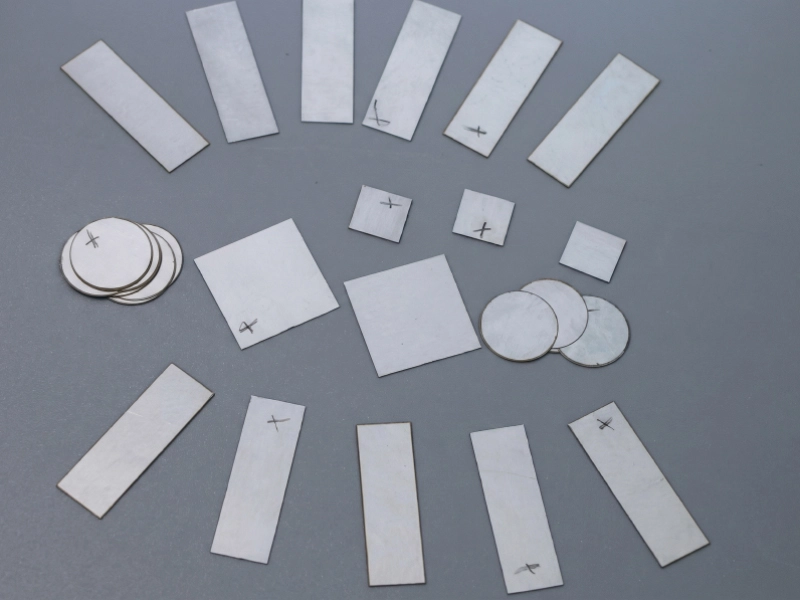
| Bulk Ferroelectric Ceramics | Diameter 10 mm, thickness 1 mm | Diameter 3–30 mm, thickness ≤ 3 mm | Double-sided silver electroded, immersed in insulating oil |
| Ferroelectric Polymer Films (e.g. PVDF) | Coupon 15×15 mm, thickness 10–50 µm | 2D dimension ≤ 15 mm | Double-sided sputtered Au/Al electrodes Ø3–5 mm |
| Substrate Thin Films (PZT/Si) | Top dot array electrodes Ø200–400 µm | Micro-manipulated probe contact | Exposed bottom electrode; coplanar or top-bottom contact |
Testing Function
Polarization-Electric field (P-E) hysteresis loop measurement is the quintessential technique for identifying spontaneous polarization, coercive electric field (Ec), and remanent polarization (Pr) in ferroelectric materials. Utilizing high-voltage biphasic drives up to ±10 kV and PUND (Positive-Up-Negative-Down) pulse protocols, our laboratory cleanly separates true domain switching polarization from parasitic resistive leakage, delivering rigorous data for ferroelectric memories, actuators, and capacitive energy-storage ceramics.
Testing Conditions
Primary Instruments: FEMS-1000
Standard Turnaround: Within 5 working days
Key Standards: ASTM D150 / IEEE Standard 180 Definitions of Terms Associated with Ferroelectric and Related Materials; IEC 62631 Standards on Dielectric and Resistive Properties
Sample Requirements
Please review the detailed specimen dimensions, electrode requirements, and poling conditions in the table above. Custom dimensions and special sample geometry can be accommodated upon technical consultation.
Testing Standards
- ASTM D150 / IEEE Standard 180 Definitions of Terms Associated with Ferroelectric and Related Materials
- IEC 62631 Standards on Dielectric and Resistive Properties
Test Results
Clients receive comprehensive test reports with raw exported ASCII/txt data files, high-resolution curve plots (temperature spectra, impedance plots, or hysteresis loops), and experimental condition parameters stamped by our CMA accredited testing center.
Turnkey Equipment for Your Own Laboratory
Prefer in-house characterization? Every test in our laboratory is performed using MatMeas turnkey instruments. Verify measurement quality with sample testing before capital procurement.
Request High-Precision Testing Solutions
Get expert guidance and customized instruments for your functional materials project.