Piezoelectric Ceramic d33 Coefficient Testing Guide
Technical News
The longitudinal piezoelectric coefficient (d33) is the critical figure of merit governing the sensitivity and electromechanical conversion efficiency of piezoelectric transducers, sensors, and actuators. While conventional quasi-static Berlincourt d33 meters provide rapid quality screening for bulk ceramics exhibiting high piezoelectric activity (e.g., standard soft PZT with d33 > 300 pC/N), they face severe measurement limitations when characterizing modern advanced functional materials.
Emerging functional electroceramics—including high-temperature bismuth layer-structured ferroelectrics (BLSFs), lead-free potassium sodium niobate (KNN), bismuth ferrite (BiFeO3), and sub-micron textured ceramics—frequently exhibit weak piezoelectric charge coefficients (d33 < 10 to 50 pC/N) combined with low electrical resistivity or lossy dielectric dissipation. Under these conditions, the minute charge signals generated by standard quasi-static mechanical loading are obscured by environmental electromagnetic interference, thermal drift, and triboelectric contact noise. Resolving weak piezoelectric coefficients requires dynamic lock-in amplification metrology capable of extracting phase-locked signals buried in noise.
Dynamic Electromechanical Metrology and Phase-Sensitive Lock-In Detection
In dynamic piezoelectric metrology, a periodic cyclic mechanical force F(t) is applied to the sample along the polarization axis:
F(t) = Fstatic + Fdyn · cos( ω · t)
where Fstatic is a constant compressive mechanical preload ensuring continuous electrical contact, Fdyn is the alternating dynamic force amplitude, and ω = 2 · π · f is the excitation angular frequency (typically selected between 10 Hz and 1 kHz).
Through the direct piezoelectric effect, this dynamic mechanical force induces an alternating electrical charge Q(t). In real functional materials, dielectric loss and ferroelastic domain wall relaxation cause a phase lag (θ) between the applied force and the generated charge:
Q(t) = Q0 · cos( ω · t − θ)
This electromechanical response is represented as a complex piezoelectric coefficient d33*:
d33* = d33′ − j · d33″
where:
- d33′ represents the real in-phase piezoelectric charge coefficient (d33′ = d33 · cos θ),
- d33″ represents the imaginary out-of-phase dissipative component (d33″ = d33 · sin θ),
- tan θ = d33″ / d33′ is the piezoelectric loss tangent.
Extracting the minute charge signal Q(t) in the presence of noise requires dynamic lock-in amplification. The charge signal is converted to voltage Vsig(t) via a high-input-impedance charge amplifier and multiplied by a synchronized reference waveform Vref(t) = V0 · cos( ω · t + ϕ).
Passing the multiplied product through an analog or digital low-pass filter with time constant τ removes AC frequency components (at ω and 2ω), yielding a pure DC output voltage proportional only to the phase-locked signal:
Vout = limT→∞ (1 / T) · ∫ Vsig(t) · Vref(t) dt = 1/2 · Vsig,0 · V0 · cos(θ − ϕ)
By utilizing dual-phase lock-in detection (multiplying simultaneously by in-phase cos ωt and quadrature sin ωt references), the instrument extracts both magnitude d33 and phase angle θ independently, achieving a signal-to-noise ratio (SNR) improvement exceeding 40 dB to 60 dB over broadband quasi-static charge integration.
Metrology Benchmarking: Dynamic Lock-In vs. Quasi-Static vs. Laser Vibrometry
Selecting the optimal piezoelectric characterization methodology depends on expected d33 magnitude, specimen stiffness, and geometry.
The benchmark table below compares the primary international techniques for longitudinal piezoelectric characterization:
| Metrology Methodology | Physical Operating Principle | Frequency Operating Range | d33 Resolution Limit | Typical Measurement SNR | Specimen Geometry Constraints | Primary Application Regime |
|---|---|---|---|---|---|---|
| Quasi-Static Berlincourt Method | Direct piezoelectric charge integration | Single frequency (typically 110 Hz) | ~0.5 to 1.0 pC/N | Moderate (15 to 25 dB); sensitive to line noise | Bulk ceramics, discs, plates (t > 0.5 mm) | Standard bulk PZT quality control and sorting |
| Dynamic Lock-In Method | Direct effect with phase-sensitive lock-in filtering | 1 Hz to 10 kHz (wide dynamic band) | 0.01 pC/N | Exceptional (>60 dB); rejects out-of-band noise | Bulk ceramics, crystals, composites, thick films | Weak piezoceramics, lossy samples, BiFeO3 |
| Laser Doppler Vibrometry (LDV) | Converse effect; optical interferometry of surface displacement | 1 kHz to 50 MHz | 0.001 nm displacement (~0.1 pm/V) | High (40 to 50 dB); sensitive to table vibration | Polished specular surfaces; thin films on rigid substrates | Thin films, MEMS diaphragms, micro-actuators |
| IEEE Resonance Impedance Method | Dynamic acoustic resonance parameter fitting | Acoustic resonance (100 kHz to 10 MHz) | Indirect derivation via k33 and compliance | High at resonance; zero off-resonance information | Strictly slender rods (L » W, T; L/T > 10) | Resonant transducers, ultrasonic motor ceramics |
Sources of Systematic Measurement Error and Calibration Protocols
Achieving measurement accuracy conforming to IEEE Std 176 and IEC 60483 requires identifying and mitigating systematic experimental error sources (including pre-measurement polarization state governed by piezoelectric ceramic polarization factors):
The diagnostic error mitigation table below outlines common sources of error and their experimental adjustments:
| Error Mechanism | Underlying Physical Phenomenon | Impact on Measured d33 | Experimental Mitigation Protocol |
|---|---|---|---|
| Excessive Clamping Pre-Stress | High static pre-stress mechanically suppresses non-180° domain wall mobility | Artificial reduction in d33 by 10% to 25% | Maintain static preload within calibrated 0.5 N to 1.5 N window |
| Non-Parallel Electrode Faces | Tilted contact surfaces generate localized shearing and bending stresses | Superimposes parasitic d31 and d15 onto d33 | Use hemispherical compliant contact probes; lap faces flat to ±1 μm |
| Electromagnetic 50/60 Hz Hum | Inductive coupling from ambient electrical mains into high-gain amplifier | Severe reading jitter; erratic d33 fluctuations | Synchronize dynamic excitation away from mains harmonics (e.g., 110 Hz) |
| Triboelectric / Pyroelectric Charge | Frictional charge accumulation or ambient thermal fluctuations during handling | Apparent DC drift; polarity-dependent magnitude error | Ground fixtures between tests; verify that reversing sample inverts sign identically |
Precision Dynamic Metrology: MatMeas PEAI-1000 System
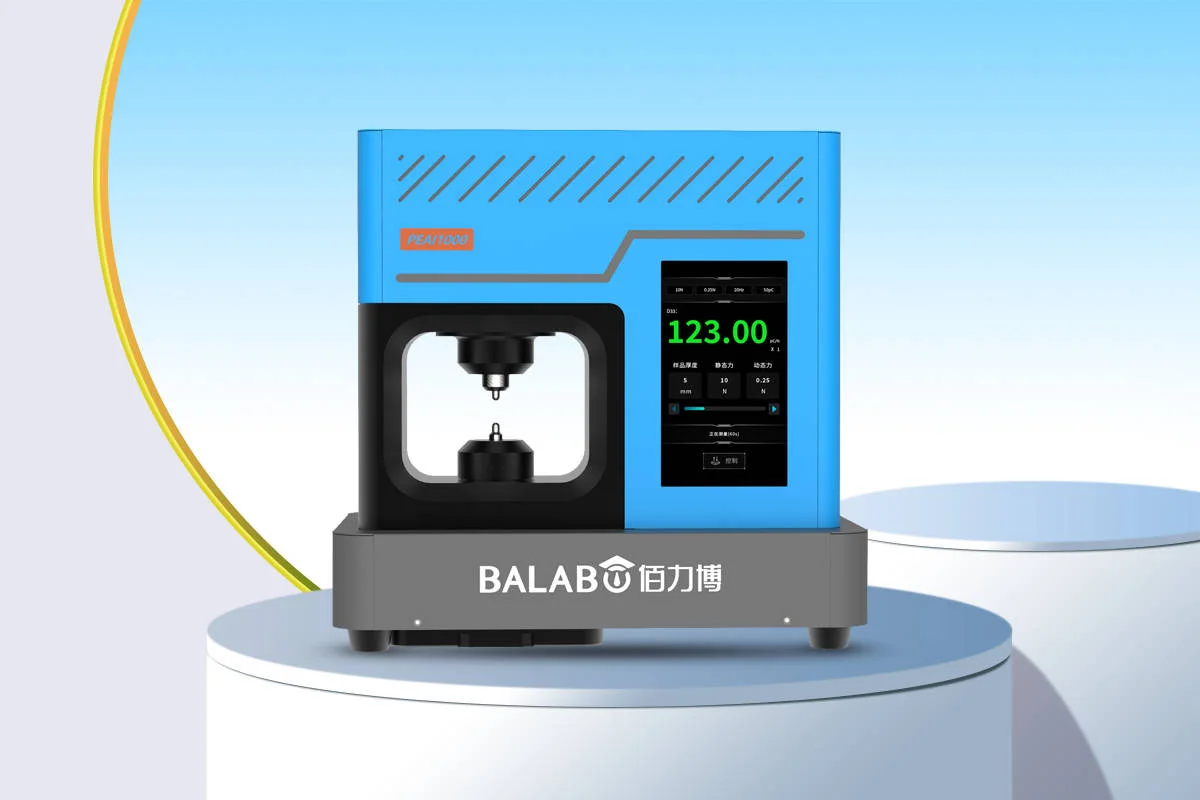
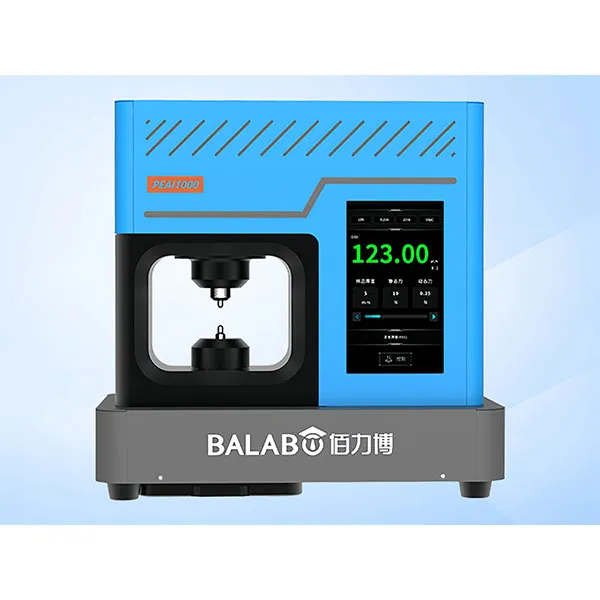
To address the characterization challenges of low-piezoelectric-coefficient, high-loss, and advanced functional ceramics, the MatMeas PEAI-1000 High Precision Piezoelectric Analyzer provides a specialized dynamic lock-in measurement platform.
Featuring a dedicated digital lock-in processing core and automated electromagnetic force excitation from 10 Hz up to 1 kHz, the PEAI-1000 resolves ultra-weak piezoelectric coefficients down to 0.01 pC/N across an expansive span up to 4,000 pC/N with ±0.5% accuracy. Its dual-phase detection architecture simultaneously extracts real piezoelectric response d33′, imaginary loss component d33″, and phase angle θ, isolating true piezoelectric signals from dielectric leakage and triboelectric noise. Closed-loop pneumatic preload regulation guarantees constant mechanical contact pressure, providing an ideal metrology testbed for bismuth layer ceramics, lead-free ferroelectrics, and high-frequency transducer components.
Frequently Asked Questions
Why is dynamic lock-in amplification superior to standard Berlincourt testing for weak piezoelectric ceramics?
Standard Berlincourt d33 meters use broadband charge integration circuits. When testing materials with weak piezoelectric coefficients (d33 < 10 pC/N), the generated charge signal is on the order of picocoulombs. At this low level, wideband ambient electromagnetic hum (50/60 Hz grid noise), thermal drift, and triboelectric charges generated by mechanical probe contact completely swamp the measurement. A dynamic lock-in amplifier multiplies the input signal by a reference frequency matched to the mechanical force driver and filters out all out-of-band noise, isolating signals that are hundreds of times smaller than the ambient noise floor.
What is the physical meaning of the imaginary piezoelectric coefficient d33'' and phase angle θ?
In ideal, loss-free piezoelectric single crystals, induced electrical charge responds instantaneously and in-phase (θ = 0°) with applied mechanical force. In real polycrystalline ceramics, ferroelastic domain wall movement and dielectric dissipation require finite relaxation time, causing generated charge to lag behind applied stress. This phase lag produces a complex piezoelectric coefficient d33* = d33′ − j · d33″. The real component d33′ represents recoverable electromechanical energy conversion, while the imaginary component d33″ represents electromechanical dissipation and mechanical-to-thermal energy conversion.
How does sample geometry affect dynamic d33 measurements?
To ensure pure longitudinal compression, the test specimen must maintain an appropriate aspect ratio. For disc geometries, the diameter-to-thickness ratio (D/t) should ideally range between 3:1 and 10:1. If a disc is too thin (D/t > 20), lateral clamping from friction between the probe tips and electrode faces restricts lateral Poisson expansion (d31), artificially reducing the measured longitudinal d33. Conversely, if a cylinder is too tall and slender (t/D > 5), mechanical misalignment can induce lateral buckling or flexural bending, introducing spurious shear charges.
Request High-Precision Testing Solutions
Get expert guidance and customized instruments for your functional materials project.