Functional Ceramics Dielectric Testing and Evaluation Guide
Technical News

Functional electroceramics—spanning high-permittivity multilayer ceramic capacitor (MLCC) formulations (BaTiO3, CaZrO3), relaxor ferroelectrics (PMN-PT), microwave communication dielectrics, and solid electrolyte ionic conductors—exhibit intricate microstructures comprising semiconducting crystalline grains, disordered intergranular grain boundaries, and electrode-material interfaces. When evaluating the electrical and dielectric performance of these complex materials, single-frequency capacitance or lumped-parameter resistance testing fails to illuminate the underlying physical conduction and relaxation mechanisms.
Electrical impedance spectroscopy (IS) and complex dielectric analysis across wide frequency (10 μHz to 30 MHz) and temperature spans (−160°C to 1000°C) serve as the definitive analytical tool to resolve multi-phase electroceramics, as detailed in our guide on dielectric temperature spectrum testing for ceramics. By plotting complex impedance in Nyquist (−Z″ vs. Z′) and Cole-Cole representations, materials scientists can deconvolve the discrete microscopic contributions of bulk grains, grain boundaries, and electrode contact barriers. Interpreting these impedance arcs requires rigorous equivalent circuit modeling and compliance with international standards.
Impedance Formalisms, the Brick-Layer Model, and Cole-Cole Dielectric Relaxation
Polycrystalline functional electroceramics are microstructurally represented by the classical Brick-Layer Model, which conceptualizes the ceramic as cubic conductive grains separated by thin, high-resistivity grain boundary layers.
Under alternating electrical excitation, four interrelated immittance formalisms are employed to represent electrical response:
- Complex Impedance: Z* = Z′ − j · Z″
- Complex Admittance: Y* = 1 / Z* = Y′ + j · Y″
- Complex Permittivity: ε* = 1 / (j · ω · C0 · Z*) = ε′ − j · ε″
- Complex Electric Modulus: M* = 1 / ε* = j · ω · C0 · Z* = M′ + j · M″
where C0 = ε0 · A / d is the vacuum capacitance of the test cell, and ω = 2 · π · f is angular frequency.
In the complex impedance plane (Nyquist plot, −Z″ vs. Z′), an ideal polycrystalline electroceramic exhibiting distinct grain (bulk), grain boundary, and electrode responses resolves into three successive semicircles traversing from high to low frequencies:
Z*( ω) = [Rg / (1 + j · ω · Rg · Cg)] + [Rgb / (1 + j · ω · Rgb · Cgb)] + [Rel / (1 + j · ω · Rel · Cel)]
where R and C designate resistance and capacitance associated with the grain (g), grain boundary (gb), and electrode (el) regions.
The characteristic relaxation frequency fmax at the apex of each semicircle is governed by its local time constant τ = R · C:
ωmax = 2 · π · fmax = 1 / τ = 1 / (R · C)
Because bulk grains possess low resistance and small dimensions (Cg ≈ 10⁻¹² to 10⁻¹¹ F), grain relaxation occurs at high frequencies (typically f > 100 kHz). Grain boundaries, being thin and defective, possess higher capacitance (Cgb ≈ 10⁻¹⁰ to 10⁻⁸ F) and higher resistance, relaxing at intermediate frequencies (100 Hz to 100 kHz). Electrode-ceramic interfacial double layers exhibit massive capacitance (Cel ≈ 10⁻⁷ to 10⁻⁵ F), appearing as a low-frequency arc or tail below 10 Hz.
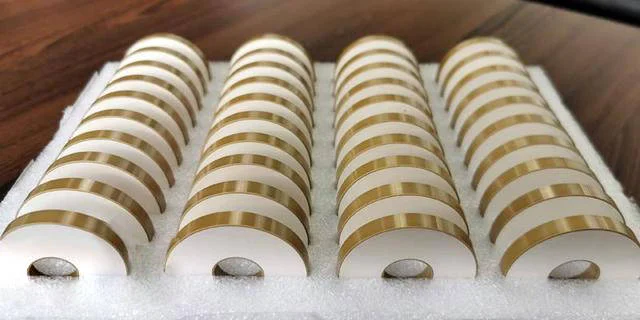
In real ceramics, non-uniform grain size distributions and distributed activation energies cause impedance semicircles to be depressed below the real axis. This non-ideal relaxation is described by the Cole-Cole relaxation model (see mathematical deconvolution in our treatise on dielectric testing Curie temperature Nyquist Cole-Cole plots):
ε*( ω) = ε∞ + (εs − ε∞) / [1 + (j · ω · τ)1−α]
where εs is static low-frequency permittivity, ε∞ is high-frequency unrelaxed permittivity, and α (0 ≤ α < 1) is the Cole-Cole distribution parameter (α = 0 represents ideal Debye single-relaxation).
Equivalent Circuit Building Blocks for Impedance Spectroscopy
To deconvolve complex microstructural responses, materials scientists fit experimental impedance spectra using equivalent electrical circuits comprising idealized passive components.
The comparative matrix below outlines the primary equivalent circuit elements, their mathematical expressions, and their physical significance in functional ceramics:
| Equivalent Circuit Element | Mathematical Admittance / Impedance | Physical Phenomenon Represented | Observable Signature in Nyquist Plot | Typical Capacitance Magnitude |
|---|---|---|---|---|
| Ideal Capacitor (C) | YC = j · ω · C | Reversible geometric electrostatic unit-cell polarization | Forms semicircle when placed in parallel with resistor R | Bulk grain: 1–10 pF/cm; Grain boundary: 0.1–10 nF/cm |
| Ideal Resistor (R) | ZR = R | Long-range DC ohmic or hopping charge transport | Diameter of semicircle along real Z′ axis | Inversely proportional to local conductivity σ |
| Constant Phase Element (CPE / Q) | YCPE = Q0 · (j · ω)n | Non-uniform interface, distributed relaxation times, surface roughness | Depressed semicircle with center shifted below Z′ axis (n < 1) | Replaces non-ideal capacitor (n = 1 represents ideal C) |
| Warburg Impedance (ZW) | ZW = σW · (1 − j) / ω0.5 | Semi-infinite linear solid-state ionic mass diffusion | Linear 45° tail extending toward low frequencies | Dominant in solid electrolytes and battery electrodes |
Dielectric Relaxation Characteristics Across Electroceramic Material Systems
Different functional ceramic formulations exhibit distinct dielectric relaxation signatures depending on defect chemistry, ferroelectric domain wall pinning, and crystal symmetry—explored in detail for electroacoustic transducers in our guide on piezoelectric ceramics relative permittivity testing and for capacitive devices in MLCC electrical performance testing and characterization.
The comparative benchmark table below outlines characteristic dielectric relaxation phenomena across primary functional ceramic systems:
| Electroceramic Material Class | Dominant Formulation Example | Characteristic Dielectric Phenomenon | Primary Impedance Arc Identified | Frequency / Temp Regime |
|---|---|---|---|---|
| Ferroelectric Perovskites | BaTiO3 / PZT-5A | Curie-Weiss phase transition; domain wall pinning | Bulk grain core vs. grain boundary space-charge layer | 100 Hz to 10 MHz; 25°C to 500°C |
| Relaxor Ferroelectrics | Pb(Mg1/3Nb2/3)O3 (PMN) | Diffuse phase transition; polar nanoregion (PNR) flipping | Broad Cole-Cole arc with high distribution parameter (α > 0.3) | 10 mHz to 1 MHz; −100°C to 150°C |
| Microwave Communication Ceramics | Ba(Mg1/3Ta2/3)O3 / MgTiO3 | Ultra-low dielectric loss (tan δ < 10⁻⁴); lattice phonon damping | High-frequency bulk arc; negligible grain boundary resistance | 1 MHz to 30 MHz (expandable to GHz) |
| High-Voltage MLCC Formulations | Core-shell BaTiO3 (X7R / X8R) | Temperature-stable permittivity; grain core-shell boundary | Dual overlapping arcs: undoped core and acceptor-doped shell | 1 kHz to 1 MHz; −55°C to 150°C |
| Solid Oxide Electrolytes | Yttria-stabilized zirconia (YSZ) / LLZO | Fast oxygen vacancy or lithium-ion hopping conduction | Bulk grain conductivity, grain boundary blocking, electrode charge-transfer | 1 Hz to 10 MHz; 200°C to 800°C |
International Standards and Metrology Protocols
Executing high-accuracy dielectric and impedance spectroscopy requires adherence to standardized testing protocols defined by ASTM D150, IEC 60250, and ISO 21712.
Critical experimental precautions include:
-
Four-Terminal-Pair (4TP) Fixture Configuration: Above 100 kHz, lead wire mutual inductance and stray cable capacitance distort high-frequency bulk grain arcs. A four-terminal-pair (4TP) coaxial cable configuration must be utilized, with shields bonded together at the fixture terminals to suppress loop currents.
-
Open / Short / Load Fixture Compensation: Prior to mounting the test specimen, full frequency-dependent open-circuit (residual stray admittance Yopen) and short-circuit (residual lead impedance Zshort) compensation must be executed at the sample stage to mathematically cancel fixture residuals:
ZDUT = (Zmeasured − Zshort) / [1 − (Zmeasured − Zshort) · Yopen]
-
Electrode Edge Margins: Sputtered or screen-printed platinum or gold electrodes must terminate 0.5 mm inside the ceramic disc perimeter to prevent edge fringing field distortions and surface flashover during high-temperature sweeps.
Broadband Dielectric Metrology: MatMeas DMS-2000 System
To resolve complex grain boundary arcs, Cole-Cole dispersions, and cryogenic-to-high-temperature phase transitions without instrumentation artifacts, the MatMeas DMS-2000 Low-Temperature Dielectric Spectrometer provides an automated characterization platform engineered for advanced functional ceramics.
Operating across a broad temperature span from −160°C up to 300°C (with liquid nitrogen cooling) and frequencies from 10 μHz to 30 MHz, the DMS-2000 integrates high-vacuum thermal chambers with four-terminal-pair shielded Kelvin micro-probes. By suppressing moisture condensation and freezing out long-range DC leakage at sub-zero temperatures, the platform resolves weak dipolar relaxations and polar nanodomain dynamics that are completely masked at room temperature. Integrated equivalent circuit fitting algorithms automatically extract bulk grain resistance Rg, grain boundary resistance Rgb, and constant phase element parameters, providing deep insight into microstructure-property relationships.
Frequently Asked Questions
How does impedance spectroscopy separate grain resistance from grain boundary resistance in functional ceramics?
Impedance spectroscopy separates grain and grain boundary contributions based on their vastly different electrical time constants (τ = R · C). Crystalline grains are thicker and more conductive, resulting in low resistance and minute geometric capacitance (Cg ≈ 1–10 pF), causing them to relax at high frequencies (f > 100 kHz). Grain boundaries are thin disordered interfaces containing high defect densities; they exhibit higher resistance and much larger capacitance (Cgb ≈ 0.1–10 nF), relaxing at lower frequencies (100 Hz to 10 kHz). In a Nyquist plot (−Z″ vs. Z′), this separation generates two distinct semicircles: the high-frequency semicircle represents the bulk grain, while the intermediate-frequency semicircle represents the grain boundaries.
Why is the Constant Phase Element (CPE) used instead of an ideal capacitor in equivalent circuit fitting?
In idealized equivalent circuits, capacitive relaxation produces a perfect semicircle centered exactly on the real Z′ axis. Real polycrystalline functional ceramics exhibit depressed semicircles whose centers lie below the real axis. This non-ideal behavior arises from microstructural heterogeneity, non-uniform grain size distributions, surface roughness, and distributed relaxation times. A Constant Phase Element (CPE) mathematically accounts for this non-ideality through the admittance relation YCPE = Q0 · (j · ω)n. When the dispersion exponent n = 1, the CPE acts as an ideal capacitor; when n < 1 (typically 0.8 to 0.95 in electroceramics), it represents a depressed relaxation arc.
What causes low-frequency upturns or tails in Nyquist impedance plots?
Low-frequency tails or large incomplete semicircles (f < 10 Hz) in Nyquist plots typically represent the electrode-material interface. When charge carriers (such as oxygen vacancies in ionic conductors or electrons in semi-insulating dielectrics) drift to the metallic electrode, they encounter an electrochemical charge-transfer barrier or non-ohmic blocking contact. This causes mobile charge carriers to accumulate at the contact interface, forming an electrical double layer. Because this interface has a very large capacitance (Cel ≈ 10⁻⁷ to 10⁻⁵ F), its relaxation time constant is enormous, producing a prominent low-frequency impedance arc or Warburg diffusion tail.
Related Instruments & Equipment
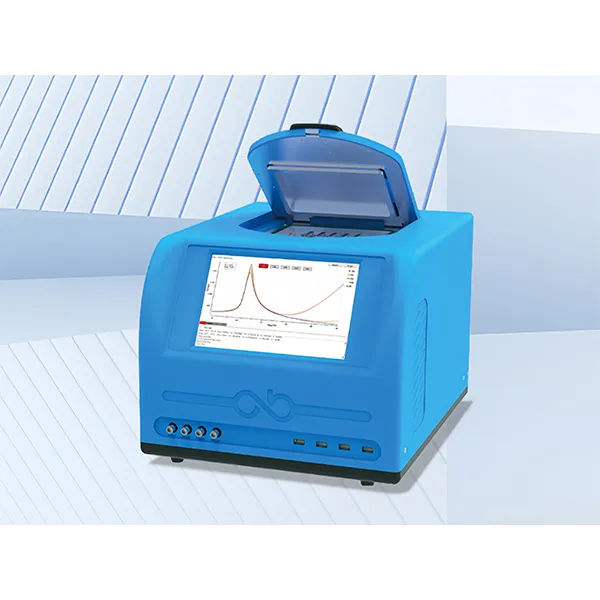
MatMeas DMS2000 High-Low Temperature Dielectric Spectrometer
The MatMeas DMS2000 is an advanced High and Low Temperature Dielectric Impedance Spectrometer engineered for evaluating the dielectric properties of materials under extreme thermal conditions. Compliant with the ASTM D150 standard, it integrates a proprietary LNP-95 liquid nitrogen injection system to achieve seamless continuous temperature variation from -160°C to 450°C. Uniquely featuring a vacuum-enabled sample chamber to completely prevent thermal frosting and eliminate false water peaks near 0°C, along with versatile options for single-sample or five-sample simultaneous testing, the DMS2000 ensures unparalleled data fidelity and high throughput for advanced scientific research.
View details →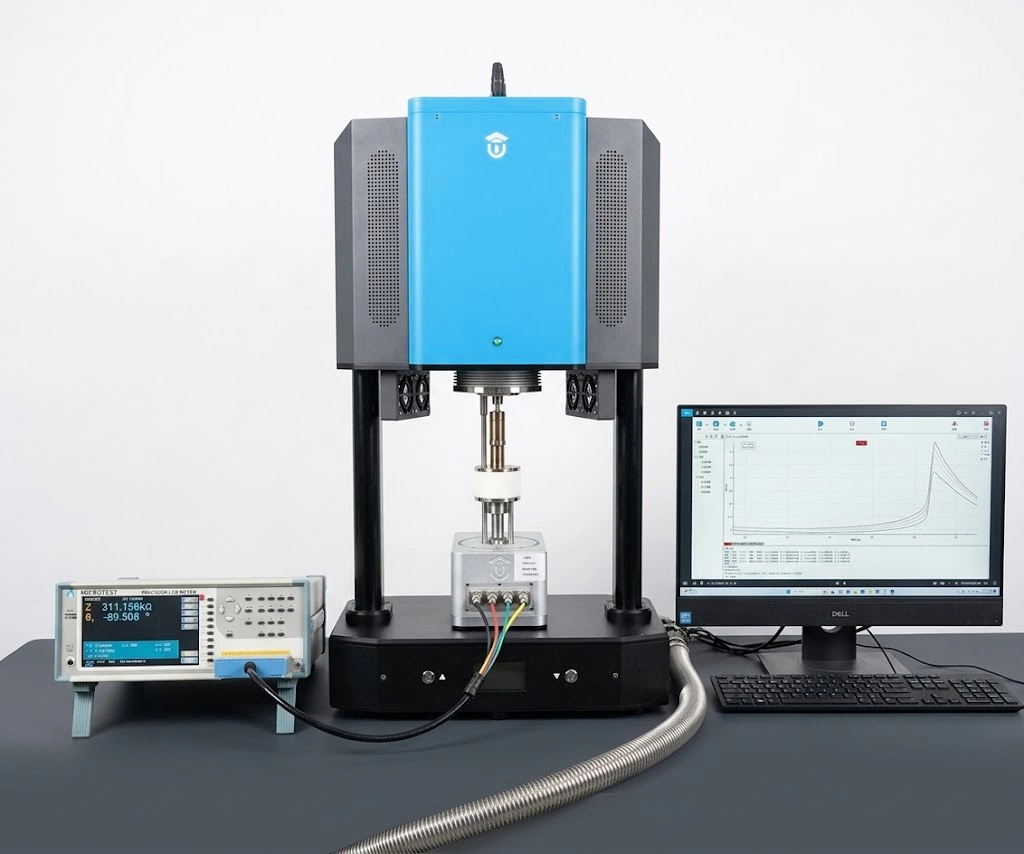
MatMeas DTS1000 High-Temperature Dielectric Impedance Spectrometer
Built on the proven DMS series platform, the MatMeas DTS1000 is a next-generation high-temperature dielectric impedance spectrometer engineered specifically for high-temperature mechanistic research on functional ceramics and advanced dielectric materials. Its modular architecture supports effortless plug-and-play switching between single-channel precision measurement and four-channel high-throughput screening. Across a wide temperature range from room temperature to 1000°C, the DTS1000 delivers fully automated, high-accuracy mapping of dielectric constant, dielectric loss, Curie temperature, and Cole-Cole/Nyquist spectra.
View details →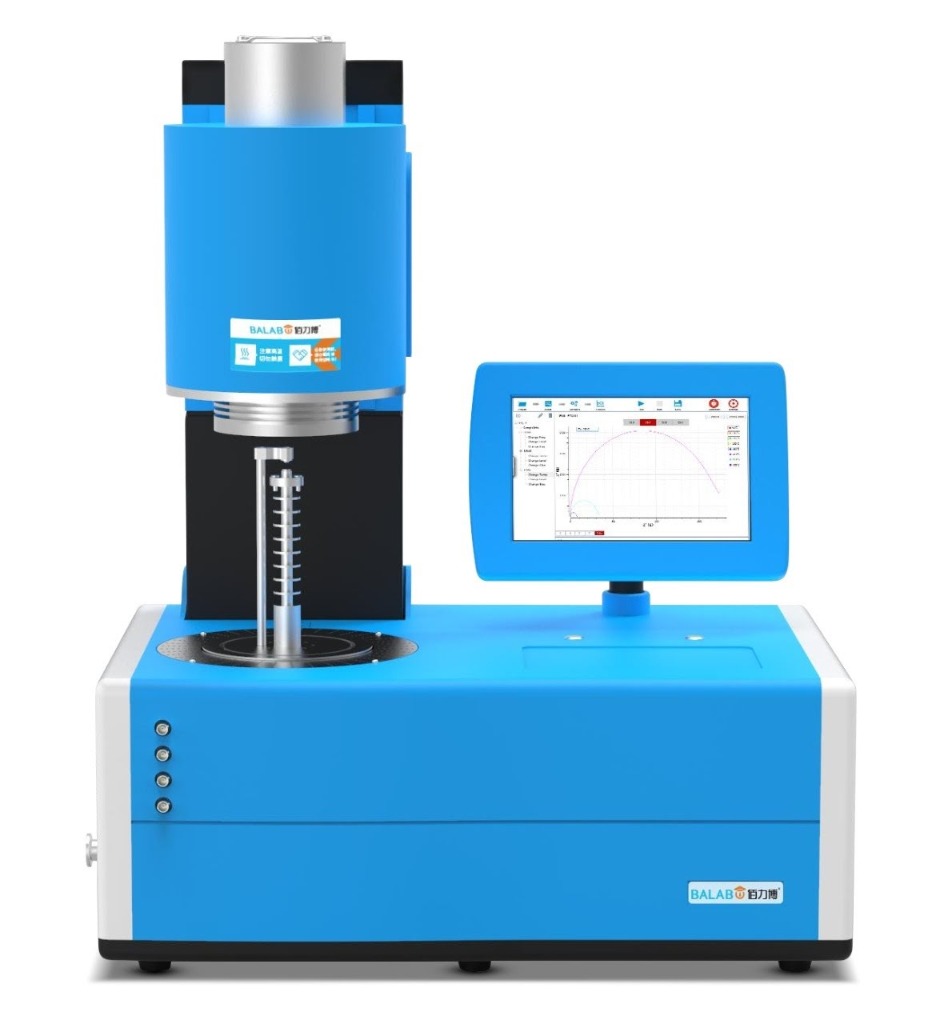
MatMeas DMS1000 High-Temperature Dielectric Spectrometer
The MatMeas DMS1000 is an advanced High-Temperature Dielectric Impedance Temperature Spectrometer engineered for the ultimate electrical characterization of bulk materials. Delivering an exceptional measurement accuracy of 0.05%, it operates efficiently from Room Temperature (RT) to 1000°C. Its upgraded platform supports both single-sample and four-sample simultaneous measurements. Integrated with a sealable metal shielding system and high-purity platinum electrodes, the DMS1000 enables highly reliable testing across inert, oxidizing, reducing, and vacuum atmospheres, making it an indispensable infrastructure for precision materials science.
View details →Request High-Precision Testing Solutions
Get expert guidance and customized instruments for your functional materials project.