Temperature-Dependent d33 Testing of Piezoelectric Films
Technical News
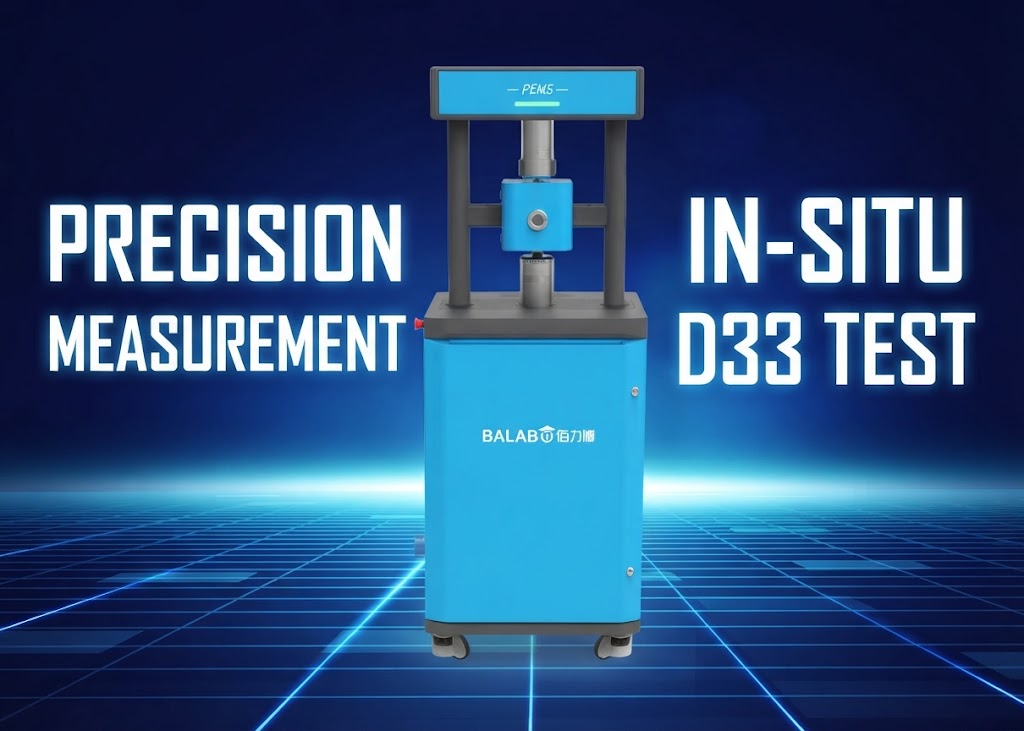
Piezoelectric thin films deployed in aerospace propulsion instrumentation, automotive combustion monitoring, deep-well geothermal exploration, and industrial ultrasonic process control must operate reliably under extreme, fluctuating thermal gradients. While baseline room-temperature testing establishes fundamental electromechanical activity, the longitudinal piezoelectric coefficient (d33) is inherently temperature-dependent. As thermal energy alters crystal lattice dimensions, mobilizes ferroelectric domain walls, and approaches polymorphic phase transitions, the piezoelectric response evolves dynamically.
Characterizing the temperature-dependent longitudinal piezoelectric coefficient, commonly designated as the d33-T spectrum, across thermal sweeps ranging from cryogenic baselines (-160°C) to extreme heat (up to 600°C or beyond) represents the definitive method for defining safe operating envelopes. However, in-situ high-temperature thin-film characterization introduces formidable experimental hurdles: thermally stimulated pyroelectric currents, mechanical contact loss caused by differential thermal expansion, and parasitic leakage conduction frequently corrupt measured signals. Overcoming these artifacts requires rigorous metrology grounded in IEEE Std 176 and IEC 60483 standards, supported by specialized in-situ instrumentation.
Physical Mechanisms Governing Thermal d33 Evolution
In polar electroceramics and ferroelectric thin films, the temperature dependence of the longitudinal piezoelectric charge coefficient d33 is governed by a delicate competition between intrinsic lattice softening and extrinsic domain wall dynamics:
- Intrinsic Lattice Softening and Dielectric Divergence: As temperature increases toward a ferroelectric-to-paraelectric Curie transition (Tc) or a polymorphic phase boundary (PPB), the crystalline lattice softens. In phenomenological Landau-Ginzburg-Devonshire (LGD) theory, the longitudinal piezoelectric coefficient scales directly with the product of electrostrictive coupling (Q11), spontaneous polarization (Ps), and relative dielectric permittivity (εr):
d33(T) = 2 * Q11 * ε_0 * ε_r(T) * P_s(T)
Below Tc, ε_r(T) surges sharply toward a dielectric peak while P_s(T) gradually decreases. In intermediate thermal regimes, the surge in permittivity frequently outpaces the decline in spontaneous polarization, causing d33 to rise to a local maximum before collapsing precipitously as thermal disorder destroys macroscopic domain alignment.
-
Extrinsic Domain Wall Depinning and Thermal Aging: In polycrystalline ferroelectric films (such as PZT or lead-free KNN), extrinsic contributions—specifically the reversible, field-induced motion of non-180° domain walls—account for 30% to 50% of the room-temperature piezoelectric response. Increasing temperature provides thermal activation energy, allowing pinned domain walls to overcome local defect barriers (such as oxygen vacancy dipoles) and increasing apparent electromechanical coupling. However, prolonged exposure to elevated temperatures drives irreversible domain randomization, resulting in permanent thermal depolarization.
-
Wurtzite Non-Ferroelectric Thermal Stability: In contrast to ferroelectric perovskites, wurtzite nitrides (such as pure AlN and ScAlN) do not exhibit ferroelectric domain switching under normal operating fields; their polarization is intrinsic to the non-centrosymmetric hexagonal lattice. Consequently, their piezoelectric coefficients remain exceptionally stable across broad thermal windows, lacking Curie transition drop-offs until reaching structural thermal decomposition thresholds exceeding 1000°C.
Benchmark Properties Across High-Temperature Piezoelectric Thin Films
Selecting thin films for harsh thermal environments requires matching maximum operating limits, retention factors, and pyroelectric cross-talk across distinct material classes.
| Thin-Film Material Class | Crystalline Structure / Symmetry | Max Continuous Operating Temp (°C) | Curie or Decomposition Temp Tc (°C) | Room-Temp Effective d33,f (pC/N) | High-Temp d33,f Retention (% @ 400°C) | Pyroelectric Coefficient p (µC/m^2·K) | Primary Thermal Degradation Limiter |
|---|---|---|---|---|---|---|---|
| Pure AlN | Wurtzite (0002) / Hexagonal P63mc | 800 - 1,000 | > 1,150 (oxidation limit) | 4.8 - 5.5 | 95% - 100% | 4 - 8 | High-temperature oxidation and substrate diffusion |
| Sc0.2Al0.8N | Scandium-substituted wurtzite | 450 - 600 | ~800 (phase separation) | 12.0 - 15.5 | 85% - 92% | 10 - 18 | Metastable rock-salt phase precipitation |
| LiNbO3 (Lithium Niobate) | Trigonal 3m / Single crystal film | 500 - 650 | 1,142 - 1,210 (Curie Tc) | 18.0 - 24.0 | 90% - 95% | 80 - 100 | Lithium out-diffusion and massive pyroelectricity |
| LGS (La3Ga5SiO14) | Langasite trigonal 32 | 850 - 1,000 | 1,470 (melting point) | 5.5 - 6.8 | 98% - 102% | 0 (non-pyroelectric) | Electrical conductivity increase at >800°C |
| Bi4Ti3O12 (BIT) | Aurivillius bismuth-layer structure | 550 - 620 | 675 (Curie Tc) | 14.0 - 20.0 | 80% - 88% | 20 - 35 | Intergranular oxygen vacancy hopping conductivity |
| High-Tc Sol-Gel PZT | Perovskite (Zr/Ti = 48/52) | 200 - 240 | 365 (Curie Tc) | 70.0 - 100.0 | 0% (depoled at >250°C) | 150 - 300 | Thermal depoling and domain back-switching |
Decoupling Piezoelectric Response from Pyroelectric Transients
The most persistent experimental artifact in dynamic d33-T characterization is the superposition of massive pyroelectric currents onto the minute piezoelectric signal. All ferroelectric and wurtzite piezoelectric materials that lack a center of symmetry and possess a unique polar axis are inherently pyroelectric.
During a continuous temperature ramp, the total instantaneous current generated across the thin-film electrodes incorporates three distinct physical contributions:
I_total(t) = d33,f * (dF/dt) + p * A * (dT/dt) + [ V(t) / R(T) ]
where d33,f is the effective longitudinal piezoelectric coefficient, dF/dt is the time rate of dynamic mechanical force application, p is the material's pyroelectric coefficient, A is the electroded active area, dT/dt is the linear heating rate (typically denoted as β in K/s), and R(T) is the internal insulation resistance of the film at temperature T.
Because pyroelectric current scales directly with heating rate (I_pyro = p * A * β), an aggressive thermal ramp of 5°C/min on a ferroelectric film with p ≈ 100 µC/m^2·K can generate pyroelectric currents exceeding tens of nanoamperes. In contrast, applying a delicate dynamic force of 0.1 N at 100 Hz on a thin film with d33,f ≈ 10 pC/N generates a peak piezoelectric displacement current of only:
I_piezo = ω * d33,f * F_dyn = 2 * π * 100 * 10 * 10^-12 * 0.1 ≈ 628 pA
Without rigorous signal decoupling, the pyroelectric DC/quasi-DC baseline completely swamps the sub-nanoampere AC piezoelectric signal, leading to catastrophic instrumentation saturation or erroneous d33 values.
Total Current Signal I_total(t)
    │
    ├── Quasi-DC Component: I_pyro = p * A * (dT/dt)  ──> High-Pass Filter Rejection
    ├── High-Temp Leakage:  I_leak = V_bias / R(T)    ──> Zero-Volt DC Offset Clamp
    │
    └── Modulated AC Carrier: I_piezo = ω * d33 * F_dyn * cos(ω*t)
                                 │
                                 ▼
                     Phase-Locked Demodulation (Ref: ω)
                                 │
                                 ▼
                     Pure Intrinsic d33,f Extraction
Decoupling is achieved through orthogonal phase-sensitive lock-in demodulation. By driving the mechanical loading at an exact reference frequency ω (e.g., 110 Hz) while holding electrical excitation strictly orthogonal to the thermal ramp, a dual-phase digital lock-in amplifier isolates the carrier frequency ω. Because thermal ramping occurs on a timescale of minutes (frequencies < 0.01 Hz), high-order bandpass filtering rejects the pyroelectric transient, extracting pure d33,f with sub-picocoulomb resolution.
| In-Situ Thermal Testing Challenge | Physical Mechanism / Manifestation | Metrological Impact on d33 Data | Engineering Elimination Protocol |
|---|---|---|---|
| Pyroelectric Current Interference | Spontaneous polarization changes with temperature (dP/dT) | Massive baseline offset; detector amplifier saturation | Dynamic lock-in bandpass filtering referenced strictly to force frequency ω |
| Differential Thermal Expansion (CTE) | Substrate (Si ~2.6 ppm/K) vs. film (PZT ~6-8 ppm/K) | Biaxial thermal stress alters domain pinning; causes cracking | Programmed micro-loading compliance; low ramp rates (≤ 2°C/min) |
| Mechanical Fixture Compliance Drift | Thermal expansion of loading rods and contact springs | Contact force relaxes or spikes uncontrollably | Closed-loop static force feedback via piezo-load cell actuator |
| Electrode High-Temp Oxidation | Metal oxidation (e.g., Al, Cu) at temperatures >300°C | Contact resistance surges; creates RC roll-off | Noble metal metallization (Pt/Au) and inert purge environment |
| Semiconducting Leakage Drop | Thermally activated carrier hopping across bandgap | Generated charge bleeds before collection | High-frequency dynamic force modulation; impedance compensation |
In-Situ Dynamic Metrology via Synchronized Thermal Control
Executing reliable d33-T spectroscopy requires an integrated test architecture that synchronizes mechanical loading, thermal control, and charge extraction into a unified feedback loop. Standalone d33 meters coupled to generic tube furnaces consistently fail due to severe thermal lag between the furnace thermocouple and the thin-film surface, erratic mechanical contact as loading rods expand, and ground loops that inject massive 50/60 Hz noise.
The MatMeas PMS-1000 piezoelectric temperature spectrum measurement system resolves these limitations through a dedicated, thermally balanced test chamber. The system deploys low-thermal-mass platinum resistance heaters positioned directly beneath the specimen backing stage, achieving synchronized temperature sweeps with stability within ±0.2°C from ambient to 600°C.
To protect delicate thin-film substrates throughout aggressive phase transformations—such as the volumetric lattice distortion accompanying the Curie transition—the MatMeas PMS-1000 incorporates an active, dynamically compliant clamping fixture. Utilizing closed-loop voice-coil or micro-stepper regulation, the fixture continuously monitors the static pre-load force via a high-temperature load cell. As thermal expansion occurs, the system micro-adjusts probe position in real time, maintaining constant mechanical contact force (regulated between 0.1 N and 0.5 N) without crushing fragile sub-micron films.
Best Practices for Specimen Mounting and Temperature Calibrations
To guarantee reproducibility when conducting temperature-dependent piezoelectric testing:
- Collinear Top/Bottom Probing: Electrodes must be contacted with collinear spherical-radius micro-probes. Misaligned probes introduce lateral bending torques that corrupt the longitudinal compressive stress tensor.
- Surface Thermocouple Placement: Temperature must be monitored using an ungrounded K-type or N-type mineral-insulated thermocouple bonded directly adjacent to the active film pad, eliminating thermal lag errors that can exceed 15°C in radiative heating chambers.
- Thermal Soak Intervals: Implement a minimum thermal dwell of 60 to 120 seconds at each measurement setpoint to ensure complete thermodynamic equilibrium across the substrate thickness prior to charge acquisition.
FAQ
Q: How does dynamic lock-in detection eliminate pyroelectric current errors during heating?
A: During thermal sweeps, the material continuously releases pyroelectric charges proportional to the heating rate (dT/dt). Because the temperature changes slowly, the pyroelectric current behaves as a quasi-DC or ultra-low-frequency baseline. By applying a sinusoidal mechanical force at a distinct frequency (e.g., 100 Hz to 200 Hz), the piezoelectric charge oscillates strictly at that carrier frequency. The phase-locked amplifier in systems like the MatMeas PMS-1000 locks onto the mechanical reference frequency and filters out all low-frequency pyroelectric currents, capturing only the true mechanical-to-electrical response.
Q: What is the physical mechanism causing sudden, irreversible d33 loss at the Curie temperature?
A: The Curie temperature (Tc) marks the thermodynamic phase transition where the non-centrosymmetric ferroelectric lattice transforms into a centrosymmetric paraelectric lattice. In ferroelectrics like PZT, this transition eliminates spontaneous polarization entirely. Once heated above Tc, internal dipoles become completely disordered. Even after cooling back to room temperature, the film remains completely depoled (d33 = 0) until an intense external DC poling electric field is re-applied.
Q: Why do non-ferroelectric wurtzite thin films (like AlN) maintain superior d33 stability at 500°C compared to PZT?
A: Wurtzite aluminum nitride (AlN) does not rely on ferroelectric domain poling for its piezoelectric behavior. Its polarization is intrinsic to its rigid covalent crystal structure, which lacks a center of symmetry up to its melting/decomposition point well above 1,150°C. In contrast, PZT relies on metastable ferroelectric domain alignment, which suffers from domain relaxation above 200°C and complete depolarization at its Curie point (~365°C), making AlN the material of choice for extreme-temperature sensing.
Related Instruments & Equipment
Request High-Precision Testing Solutions
Get expert guidance and customized instruments for your functional materials project.