Polymer Film Voltage Breakdown Testing Guide
Technical News

From lithium-ion battery separators in electric vehicle drivetrains to metallized dielectric films in pulsed energy-storage capacitors, flexible printed circuits, and aerospace power cabling, polymer dielectric films serve as foundational insulation across modern electrical systems. In every demanding application, operational safety, energy density, and component longevity depend on a governing metric: dielectric breakdown resistance. Voltage breakdown testing represents the premier metrological methodology for determining the electrical insulation limits, dielectric strength, and failure thresholds of polymeric membranes under intense electrical stress.
As operational voltages surge in 800V automotive architectures and form factors continue to shrink, dielectric films experience harsher electrical gradients. Battery separators must withstand high-voltage pulses without pinhole micro-punctures or thermal runaway. Polyimide (PI) films must retain electrical isolation at temperatures exceeding 200°C. Biaxially oriented polypropylene (BOPP) capacitor films require sustained resistance against high-frequency alternating electric fields. Consequently, voltage breakdown characterization has transitioned from basic batch inspection into an essential quantitative engineering discipline.
Dielectric Breakdown Fundamentals in Thin Polymeric Films
Dielectric breakdown occurs when the electric field applied across an insulating membrane exceeds its dielectric strength, triggering an irreversible transition from an electrical insulator to a low-resistance conductive plasma channel. Paralleling the damage models described in ceramic voltage breakdown testing principles and factors, dielectric failure in polymer thin films is governed by three coupled physical mechanisms:
- Intrinsic Electronic Avalanche Breakdown: Under intense local electric fields (typically exceeding 300 to 800 MV/m), free conduction-band electrons gain kinetic energy faster than they can dissipate it through lattice phonon collisions. These hot electrons trigger impact ionization of polymer macromolecules, creating an avalanche multiplication of electron-hole pairs that causes an instantaneous conductive discharge within nanoseconds.
- Thermal Breakdown: Alternating electric fields and localized leakage currents generate internal Joule heating (
W = E^2 * σ + ω * E^2 * ε_0 * ε_r * tan δ). If the rate of heat generation exceeds thermal dissipation to the surroundings, localized temperature escalates exponentially, causing polymer melting, thermal degradation, and catastrophic puncture along the hot channel. - Stark-Garton Electromechanical Breakdown: High voltage induces massive electrostatic Maxwell compressive stress (
P_elec = 0.5 * ε_0 * ε_r * E^2) across the film thickness. When electrostatic compressive pressure exceeds the viscoelastic elastic modulus (Y) of the polymer matrix, physical thickness contraction occurs, exponentially raising the instantaneous electric field until mechanical collapse ensues. The theoretical Stark-Garton electromechanical breakdown limitE_EMis defined by:
E_EM = sqrt( Y / ( ε_0 * ε_r * exp(1) ) )
where Y is Young's modulus, ε_0 is vacuum permittivity, and ε_r is relative permittivity.
Benchmark of Industrial Dielectric Polymer Films
Selecting polymeric dielectrics requires balancing dielectric strength, permittivity, dielectric loss, and thermal operating limits.
| Polymer Film Material | Chemical Class / Trade Reference | Typical Thickness Range (μm) | Relative Permittivity εr (1 kHz) | Volume Resistivity (Ω·cm) | DC Breakdown Strength (MV/m) | AC Dielectric Strength (kV/mm) | Max Operating Temperature (°C) | Primary Electronic Application |
|---|---|---|---|---|---|---|---|---|
| BOPP | Biaxially Oriented Polypropylene | 2.5 - 12.0 | 2.2 - 2.3 | > 10^16 | 600 - 750 | 250 - 320 | 105 | DC-link film capacitors for EV traction inverters |
| PI (Kapton) | Aromatic Polyimide | 12.5 - 50.0 | 3.4 - 3.5 | > 10^15 | 300 - 450 | 150 - 220 | 260 - 300 | High-temperature flexible circuits, aerospace motor slot liners |
| PET (Mylar) | Polyethylene Terephthalate | 3.0 - 25.0 | 3.2 - 3.4 | > 10^15 | 350 - 500 | 180 - 240 | 130 | General-purpose decoupling capacitors, barrier films |
| PTFE (Teflon) | Polytetrafluoroethylene | 25.0 - 100.0 | 2.0 - 2.1 | > 10^17 | 400 - 550 | 120 - 180 | 260 | High-frequency microwave interconnects, coaxial cable insulation |
| PE Separator | Microporous Polyethylene | 9.0 - 20.0 | 1.8 - 2.1 (Porous) | > 10^14 | 120 - 180 | 60 - 90 | 90 - 105 | Lithium-ion battery separators, electrochemical cells |
| PVDF | Polyvinylidene Fluoride | 10.0 - 40.0 | 10.0 - 12.0 | > 10^12 | 250 - 350 | 100 - 150 | 120 | Piezoelectric sensors, high-energy-density pulse capacitors |
BOPP delivers exceptional DC dielectric strength combined with ultra-low dielectric loss (tan δ < 0.0002), making it the benchmark dielectric for high-power DC-link capacitors. Polyimide provides unmatched thermal stability, maintaining electrical isolation at temperatures where aliphatic polymers melt.
Statistical Analysis via Two-Parameter Weibull Distributions
Because dielectric breakdown in solid polymers is a stochastic defect-driven process governed by microstructural voids, molecular weight dispersity, and dust inclusions, single arithmetic average values are misleading. International testing standards require two-parameter Weibull statistical modeling (consistent with the weakest-link failure models in ceramic substrate breakdown testing DC vs AC technology):
P(E) = 1 - exp[ - ( E / α )^β ]
Linearizing the cumulative failure probability P(E) yields:
ln[ -ln( 1 - P(E) ) ] = β * ln(E) - β * ln(α)
where:
E: Applied electric field at puncture (kV/mm or MV/m).α: Characteristic breakdown scale parameter, representing the electric field at which 63.2% of the tested specimens fail.β: Weibull shape modulus, representing data dispersion. A high shape parameter (β > 15) signifies high manufacturing consistency and minimal defect agglomeration, whereas a low value (β < 8) indicates wide defect distributions or thickness non-uniformities.
In multi-point automated testing, cumulative failure probabilities for N sequentially ordered breakdown points are calculated using Bernard's median rank approximation:
P_i = ( i - 0.3 ) / ( N + 0.4 )
Plotting ln[-ln(1 - P_i)] versus ln(E_i) yields the characteristic breakdown strength and shape parameter directly from linear regression slope and intercept.
Test Methodologies and ASTM D149 Electrode Configurations
Accurate breakdown testing requires strict control over electrode geometry, mechanical contact pressure, voltage ramp rates, and dielectric immersion media to prevent premature surface flashover—as also established for brittle electroceramics in our piezoelectric ceramics voltage breakdown testing guide.
| Electrode Geometry | ASTM D149 / IEC 60243-1 Specification | Electric Field Distribution | Edge Electric Stress Concentration | Recommended Specimen Thickness | Metrological Use Case |
|---|---|---|---|---|---|
| Opposing Cylinders (Equal Diameter) | 25 mm diameter brass cylinders with 2.5 mm edge radius | Uniform across center; high field fringing at radius | Moderate | 0.5 mm to 3.0 mm | Standard rigid plastic and thick sheet material qualification |
| Unequal Opposing Cylinders | Top: 25 mm diameter; Bottom: 75 mm diameter plate | Asymmetrical ground plane field distribution | High at upper perimeter edge | 0.1 mm to 1.5 mm | Standard thin film and sheet dielectric screening |
| Opposing Spheres (Ball-on-Ball) | 12.7 mm diameter polished stainless steel balls | Point-contact localized maximum field | Low (tangential divergence) | < 0.25 mm (Thin films) | Thin capacitor films; minimizes interfacial air gap entrapment |
| Multi-Point Array Probes | Automated multi-head rounded tip pins (r = 1.0 mm) | Highly localized point field mapping | Minimal lateral tracking | < 0.10 mm (Sub-micron to thin foils) | Automated spatial uniformity mapping and Weibull distribution extraction |
Immersing thin-film test fixtures in high-purity methyl silicone oil is vital. Ambient air exhibits a breakdown strength of approximately 3 kV/mm, causing surface corona and edge flashover long before polymer films reach their intrinsic puncture limits (exceeding 200 kV/mm). Silicone oil eliminates interfacial air gaps, suppress discharges, and guarantees that measured voltages reflect true bulk puncture.
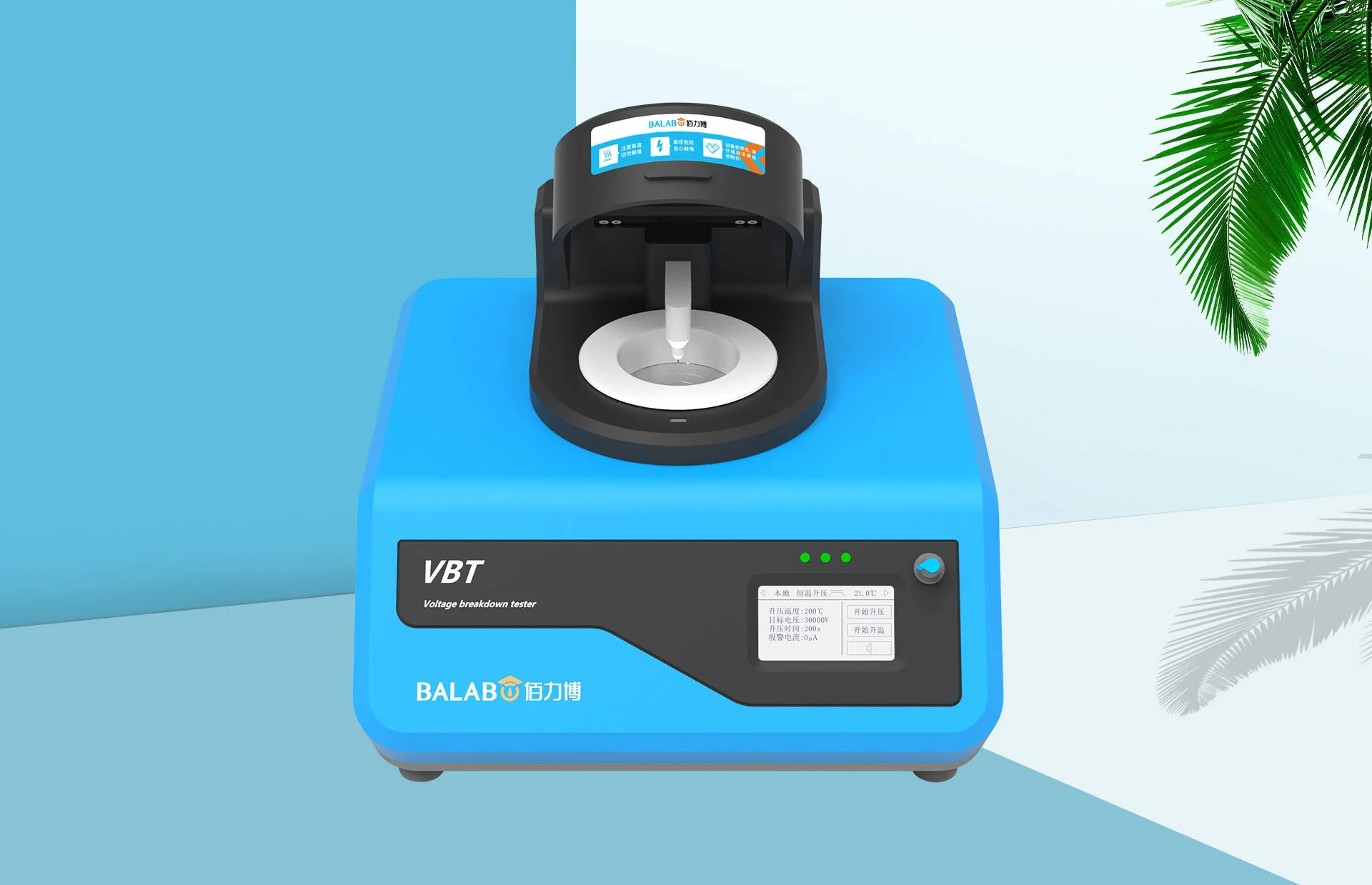
High-Voltage Breakdown Characterization with MatMeas VBT-30kV
Evaluating the dielectric strength of ultra-thin films requires instrumentation combining high-voltage resolution, programmable ramp profiles, and microsecond-level arc suppression.
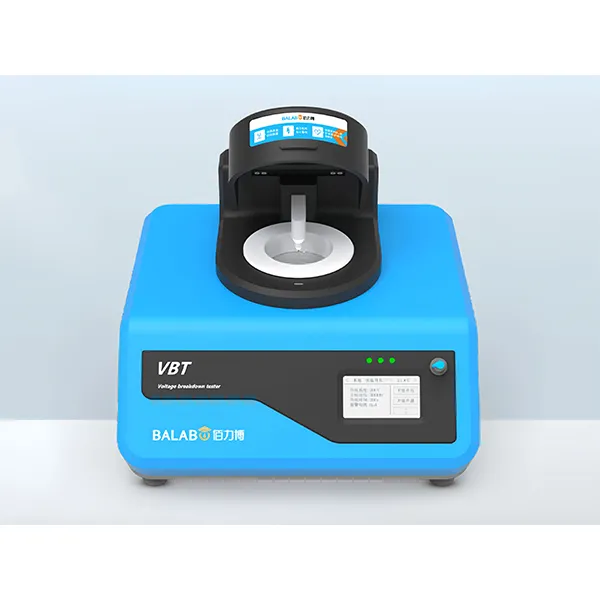
The MatMeas VBT-30kV Voltage Breakdown Tester provides an automated testing platform engineered for high-precision dielectric strength characterization of polymer films, ceramics, and composite membranes. Delivering continuously adjustable DC or AC test voltages up to 30 kV with ±1% measurement accuracy, the system supports both continuous linear ramping (from 50 V/s up to 5000 V/s) and multi-stage stepped withstand voltage protocols.
Equipped with an integrated silicone oil bath chamber featuring PID temperature regulation up to 180°C, the VBT-30kV enables researchers to record temperature-dependent dielectric breakdown curves under controlled conditions. High-speed electronic trip circuits isolate high voltage within microseconds upon sensing leakage current thresholds (programmable from 10 μA to 20 mA), preventing destructive arc carbonization and preserving microscopic puncture crater morphology for post-breakdown scanning electron microscopy (SEM) analysis.
Frequently Asked Questions
Why is dielectric breakdown testing of polymer films conducted in silicone oil?
Thin polymer films possess dielectric breakdown strengths between 100 MV/m and 700 MV/m, whereas ambient air breaks down at approximately 3 MV/m. Testing thin films in air causes electrical discharges to track across the sample surface or spark from electrode edges, producing false flashover data. Immersing the specimen in silicone oil suppresses air ionization, ensuring the measured voltage represents true bulk dielectric puncture.
What is the physical significance of the Weibull shape parameter beta?
The Weibull shape parameter beta quantifies the statistical scatter of breakdown voltages. A high beta value (e.g., beta > 15) indicates a narrow failure distribution, reflecting high film thickness uniformity, clean polymer synthesis, and low defect density. A low beta value reveals widespread microstructural flaws, void clusters, or particulate contamination that cause premature, erratic dielectric breakdown.
How does voltage ramp rate influence the measured dielectric strength?
Higher voltage ramp rates typically yield higher apparent breakdown voltages. Under slow ramp rates, the polymer undergoes prolonged electrical and thermal stress, allowing time-dependent space-charge accumulation, partial discharge degradation, and localized Joule heating to develop. Standardized protocols like ASTM D149 specify standard ramp rates (such as 500 V/s) to ensure cross-laboratory reproducibility.
Request High-Precision Testing Solutions
Get expert guidance and customized instruments for your functional materials project.