Ceramic High-Temperature Resistivity Testing: Principles and Quality Control
Technical News
From thermal barrier structures in aerospace propulsion to refractory insulators in nuclear power systems, spark plug insulators in automotive engines, and solid oxide electrochemical cells, advanced technical ceramics serve as the premier inorganic electrical isolation platform. While structural and functional ceramics—such as high-purity alumina (Al2O3), yttria-stabilized zirconia (3Y-TZP), silicon nitride (Si3N4), mullite, and steatite—exhibit room-temperature electrical volume resistivities exceeding 10^14 Ω·cm, their insulating properties undergo steep degradation as temperatures escalate. Ceramic high-temperature resistivity testing provides the quantitative foundation required to map thermal defect activation, evaluate sintering consistency, and safeguard against in-service dielectric breakdown.
Evaluating volume and surface resistivity across extended thermal sweeps establishes safe operational limits and enables proactive quality screening before components undergo high-cost brazing, metallization, and final module packaging, complementing characterizations in our ceramic substrate resistivity testing from cryogenic to high temperature guide.
The Physical Mechanisms of High-Temperature Conduction in Technical Ceramics
Electrical conduction in technical ceramics at temperatures above 300°C shifts from electronic band transport to defect-mediated ionic and polaron hopping, analyzed mathematically in our treatise on high-temperature resistance and resistivity testing. The temperature dependence of electrical conductivity σ(T) is governed by the defect-hopping Arrhenius relation:
σ(T) = ( σ_0 / T ) * exp( -E_hop / ( k_B * T ) )
where σ_0 is a pre-exponential factor related to mobile defect concentration and lattice jump frequency, E_hop is the activation energy for charge carrier migration, k_B is the Boltzmann constant (8.617 * 10^-5 eV/K), and T is absolute temperature in Kelvin.
- Oxygen Vacancy Migration: In oxide ceramics (such as zirconia and alumina), thermal reduction creates doubly ionized oxygen vacancies (
V_O^••) governed by Kroger-Vink equilibrium:
O_O^x <=> V_O^•• + 2 e' + 0.5 O_2(g)
At elevated temperatures, these vacancies hop across adjacent oxygen lattice sites with low activation energy (typically 0.8 eV to 1.2 eV in zirconia), causing electrical resistivity to plummet by up to eight orders of magnitude. 2. Grain Boundary Glass-Phase Conduction: Sintering aids (such as silicate, calcia, or magnesia additives) segregate to intergranular boundaries, forming amorphous glassy interlayers. Above their glass transition temperatures (typically 500°C to 700°C), mobile alkali (Na+, K+) and alkaline-earth ions diffuse rapidly along grain boundaries. 3. Impurity and Polaron Hopping: Trace transition metal impurities (such as Fe2+/Fe3+ or Ti3+/Ti4+) facilitate small polaron hopping, contributing an electronic leakage component that accelerates under high electrical fields.
Benchmark of Technical Ceramics High-Temperature Volume Resistivity
Selecting ceramics for extreme thermal environments requires comparing their volume resistivities, activation energies, and primary conduction mechanisms across wide temperature sweeps.
| Technical Ceramic Class | Formulation / Grade | 100°C Volume Resistivity (Ω·cm) | 300°C Volume Resistivity (Ω·cm) | 600°C Volume Resistivity (Ω·cm) | 800°C Volume Resistivity (Ω·cm) | Activation Energy E_hop (eV) | Primary High-Temperature Conduction Limiter |
|---|---|---|---|---|---|---|---|
| High-Purity Alumina | 99.5% Al2O3 (CoorsTek AD-995) | > 10^15 | 5.0 * 10^13 | 8.0 * 10^9 | 1.2 * 10^7 | 1.40 - 1.70 | Intrinsic oxygen vacancy hopping along grain boundaries |
| Yttria-Stabilized Zirconia | 3Y-TZP Structural Grade | 1.0 * 10^12 | 2.0 * 10^8 | 4.0 * 10^4 | 5.0 * 10^2 | 0.85 - 1.05 | High oxygen vacancy mobility in stabilized tetragonal lattice |
| Silicon Nitride | Gas-Pressure Sintered Si3N4 | > 10^14 | 1.5 * 10^12 | 6.0 * 10^8 | 8.0 * 10^5 | 1.10 - 1.30 | Rare-earth oxynitride glassy grain boundary phase softening |
| Mullite | 3Al2O3·2SiO2 Refractory Grade | 5.0 * 10^13 | 8.0 * 10^10 | 2.0 * 10^7 | 1.0 * 10^5 | 0.95 - 1.20 | Viscous grain boundary silicate phase alkali migration |
| Steatite (L-3/L-5) | Magnesium Silicate (MgSiO3) | 1.0 * 10^14 | 3.0 * 10^11 | 5.0 * 10^7 | 3.0 * 10^5 | 0.90 - 1.15 | Intergranular glass phase alkali ion conduction |
While structural zirconia exhibits remarkable mechanical toughness at room temperature, its high oxygen vacancy concentration transforms it into a fast-ion conductor above 600°C. In contrast, 99.5% alumina maintains superior volume resistivity (exceeding 10^7 Ω·cm at 800°C), making it the gold standard for high-temperature electrical feedthroughs and furnace insulation.
High-Temperature Electrode Systems and Metallization
Obtaining reproducible electrical resistivity measurements up to 800°C requires choosing electrode systems that resist oxidation, thermal delamination, and metal ion diffusion into the ceramic lattice.
| Electrode Deposition System | Thickness Range (μm) | Max Temperature in Air (°C) | Chemical Reactivity and Diffusion | Contact Resistance | Sintering / Application Protocol | | :--- | :--- | :--- | :--- | :--- | :--- | :--- | | Fired Platinum Paste | 5.0 - 15.0 | 1000 | Inert; zero oxygen diffusion into specimen | Ultra-low ohmic contact | Screen printed; fired at 950°C to 1100°C in air | | Fired Silver Paste | 10.0 - 25.0 | 550 | Silver ion electromigration above 400°C under DC field | Low ohmic contact | Screen printed; fired at 600°C to 850°C in air | | Sputtered Gold / Platinum | 0.2 - 0.5 | 600 | Minimal reaction; thin film agglomeration above 600°C | Low contact resistance | DC magnetron sputtering; requires polished ceramic face | | Colloidal Graphite | 10.0 - 30.0 | 450 (Air) / 1000 (Vacuum) | Burns off in oxidizing air; stable in inert/vacuum | Moderate | Painted or airbrushed; air dried at 120°C |
Fired platinum paste represents the definitive benchmark for testing up to 800°C and beyond in oxidizing environments. Base-metal electrodes oxidize rapidly, creating parasitic interfacial oxide layers that mask the true resistance of the ceramic.
Guarded Three-Ring Electrode Metrology Conforming to ASTM D257
Accurate measurement of volume resistivity in ultra-high-resistance ceramics (often spanning from 10^6 Ω to 10^15 Ω) requires eliminating surface leakage currents and fringing field distortion. Standardized testing utilizes the three-ring guarded electrode configuration conforming to ASTM D257 and IEC 60093, adhering to the analytical equations detailed in volume resistivity testing of solid insulating materials using the three-electrode method.
The three-ring geometry consists of:
- Central Measurement Electrode (d1): Applied to the upper face to collect current passing through the bulk volume.
- Concentric Guard Ring (d2): Surrounds the central electrode with an annular gap
g. By maintaining the guard ring at the same potential as the central electrode, surface leakage currents are intercepted and routed directly to system ground without passing through the electrometer. - Unguarded Counter-Electrode (d3): Covers the opposing face, connected to the high-voltage DC excitation source.
The effective measurement area A_eff and volume resistivity ρ_v are computed using geometric correction formulas:
A_eff = ( π / 4 ) * ( d1 + g )^2
ρ_v = R_v * ( A_eff / t )
where R_v is measured volume resistance in ohms and t is specimen thickness in centimeters.
Quality Assurance and Batch Screening Across Industrial Sectors
High-temperature resistivity testing acts as an essential quality control gate across multiple manufacturing sectors:
- Detection of Sintering Pores and Microcracks: Microscopic pores from incomplete sintering or poor binder burnout reduce the effective cross-sectional area. Under electric fields, localized field concentrations accelerate ionic migration, triggering early resistance drops.
- Raw Material Purity Auditing: Trace iron, sodium, or potassium impurities at parts-per-million levels migrate to grain boundaries during firing. Temperature-dependent resistivity curves expose contaminated raw powder lots that easily pass room-temperature screening.
- Power Module Substrate Qualification: Verifies that Direct Bonded Copper (DBC) and Active Metal Brazed (AMB) ceramic substrates retain adequate insulation resistance under continuous 800V operating conditions.
High-Temperature Resistivity Characterization with MatMeas HTS-1000HR
Meeting the rigorous demands of industrial quality control requires metrology equipment combining wide resistance dynamic range with precise thermal stabilization.
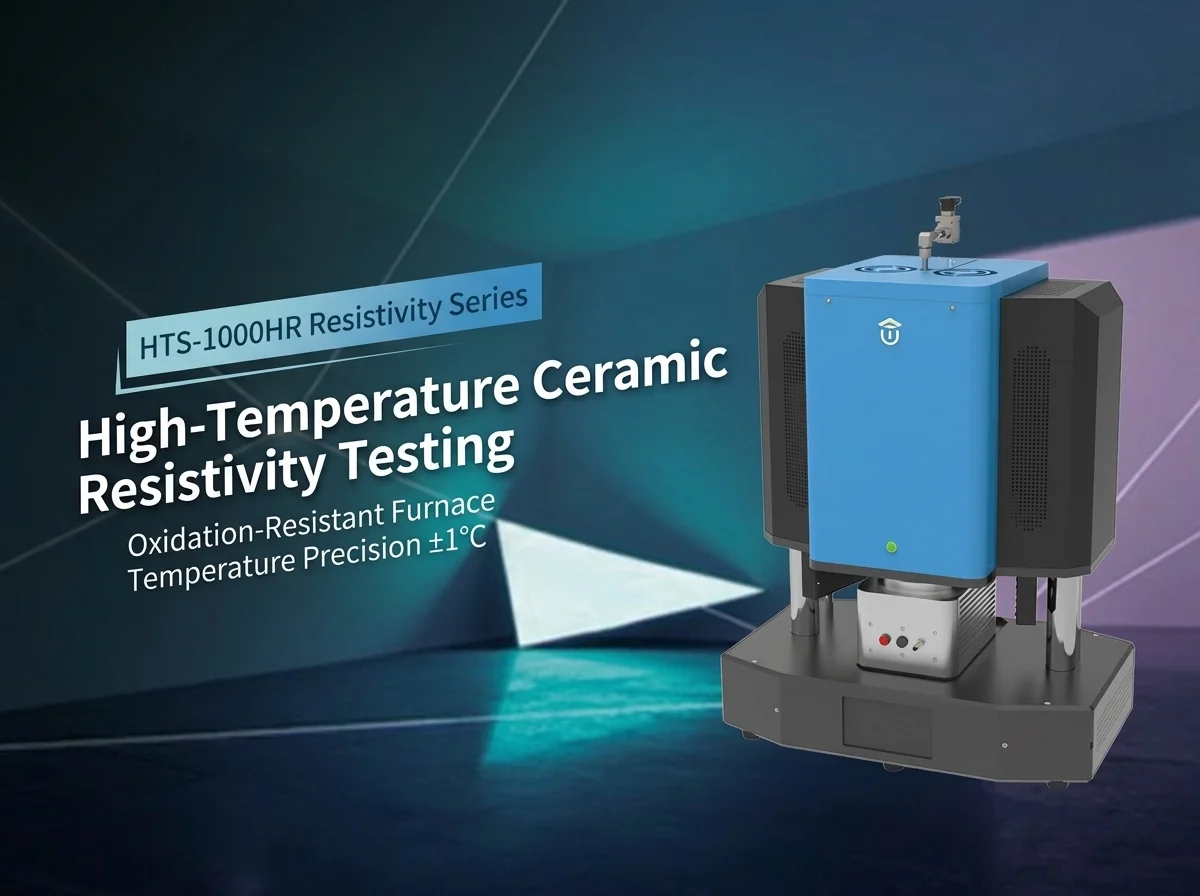
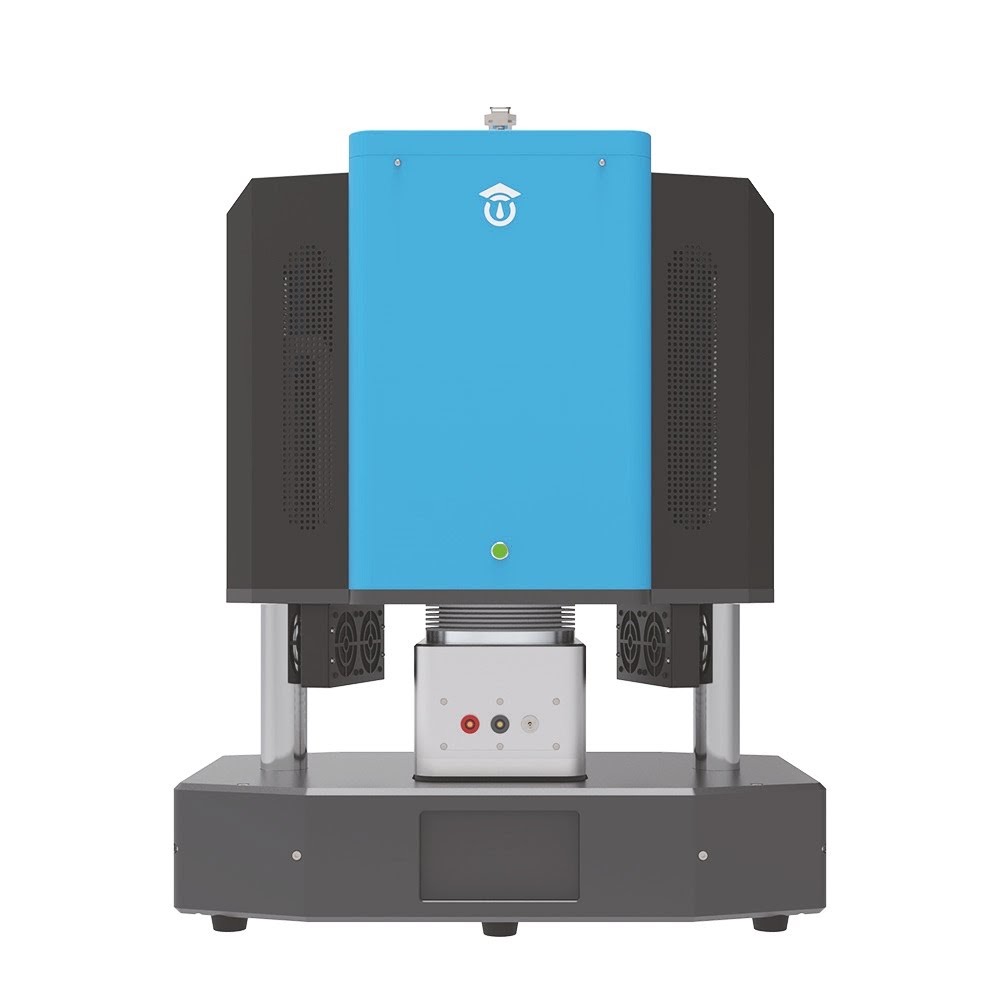
The MatMeas HTS-1000HR High Temperature Resistivity Measurement System is engineered specifically to evaluate the electrical insulation and resistivity limits of technical ceramics and advanced functional materials.
Key technical specifications of the HTS-1000HR include:
- Wide Thermal Operating Range (Ambient to 800°C): Features an oxidation-resistant tube furnace with digital PID temperature regulation (±1°C), supporting programmable multi-segment heating profiles.
- Broad Resistance Dynamic Range (10^3 Ω to 10^15 Ω): High-precision electrometer input resolves leakage currents from 500 fA to 20 mA.
- ASTM D257 Guarded Platinum Fixtures: Equipped with high-purity platinum electrodes implementing the guarded three-ring method to isolate bulk volume resistivity.
- Calibrated Specimen Clamping: Calibrated contact pressure (max 0.25 N) prevents mechanical crushing or microcracking in delicate substrate discs up to 30 mm in diameter and 5 mm thickness.
- Multi-Atmosphere Capability: Supports testing in ambient air, flowing inert or reactive gases, and vacuum environments to replicate real operating conditions.
Frequently Asked Questions
Why does ceramic resistivity decrease exponentially at high temperatures?
In solid inorganic insulators, electrical conduction is thermally activated according to the Arrhenius relationship. As temperature rises, thermal energy promotes charge carriers and increases the mobility of lattice defects (such as oxygen vacancies and mobile alkali ions), causing volume resistivity to drop sharply. The HTS-1000HR system tracks this exponential decay from room temperature to 800°C with ±1°C stability, allowing engineers to verify insulation thresholds under actual operational conditions.
How does the three-ring electrode method eliminate surface leakage errors?
In ultra-high-resistance measurements, surface contamination and humidity create parallel leakage paths that can be orders of magnitude larger than the true volume current. The three-ring electrode configuration surrounds the central sensing electrode with an equipotential guard ring connected to system ground. Any current traveling across the surface is shunted directly to ground, ensuring the electrometer measures only current passing through the bulk ceramic volume.
Why is electrode oxidation a critical issue during high-temperature resistivity testing?
Standard base-metal electrodes (such as brass or copper) oxidize rapidly when heated above 400°C in ambient air, creating resistive oxide scales that distort low-current readings. The MatMeas HTS-1000HR resolves this challenge by utilizing non-oxidizing, high-purity platinum electrodes alongside a sealed test chamber that supports inert gas, vacuum, or flowing gas atmospheres up to 800°C.
Request High-Precision Testing Solutions
Get expert guidance and customized instruments for your functional materials project.