Piezoelectric Ceramics Voltage Breakdown Testing: Mechanisms and Evaluation
Technical News
Piezoelectric ceramics serve as the electromechanical core of ultrasonic power transducers, micro-positioning nanopositioners, acoustic emission sensors, and pulse generators. The operational limits and conversion efficiency of these electroceramics depend directly on their capacity to withstand intense electric fields during manufacturing high-voltage poling and continuous resonant actuation. Dielectric breakdown testing establishes the absolute electrical endurance ceiling of piezoelectric ceramics, safeguarding against catastrophic punch-through, thermal runaway, and premature component degradation.
Unlike passive ceramic insulators, piezoelectric ceramics experience high static and dynamic electric fields during service. Characterizing breakdown voltage under controlled ramp rates, variable temperatures, and dielectric immersion environments enables materials engineers to push poling limits safely, optimize sintering microstructures, and establish robust safety margins for aerospace, automotive, and industrial acoustic systems.
Strategic Role of Voltage Breakdown in Piezoelectric Ceramics
Dielectric withstand capability represents the definitive reliability boundary for functional ferroelectric components across their lifecycle:
- Manufacturing Poling Safeguards: Before acquiring macroscopic piezoelectric activity, ferroelectric domains within randomly oriented grains must be aligned via high-voltage DC poling fields typically 2 to 3 times the coercive field (
E_c), following procedures detailed in our treatise on piezoelectric polarization mechanisms and methods. Inadequate dielectric breakdown strength causes catastrophic electrical puncture during poling, destroying the specimen and reducing manufacturing yield. - In-Service High-Power Drive: In high-power ultrasonic welding, medical lithotripsy, and naval sonar projectors, ceramics operate under large AC electric fields. Repeated dynamic cycling generates internal dielectric losses and mechanical stresses. Dielectric breakdown testing verifies that the material withstands peak electric drive fields without initiating partial discharge erosion.
- Miniaturization of Multi-layer Actuators: High dielectric breakdown strength allows multi-layer actuators (MLCAs) to use thinner ceramic layers (down to 20 to 50 μm), enabling higher electric fields and stroke displacements at low operating voltages.
Benchmark of Dielectric Strength and Poling Thresholds Across Piezoelectric Formulations
Different ceramic formulations possess vastly different grain sizes, coercive fields, and breakdown thresholds.
| Ceramic Formulation | Dopant Classification | Average Grain Size (μm) | Coercive Field Ec (kV/mm) | Breakdown Strength in Air (kV/mm) | Breakdown Strength in Silicone Oil (kV/mm) | Recommended Safe Poling Field (kV/mm) | Dielectric Strength Margin (E_bd / E_pol) |
|---|---|---|---|---|---|---|---|
| PZT-4 | Hard PZT (Acceptor-doped) | 3.0 - 5.0 | 1.8 - 2.2 | 2.5 - 3.5 | 12.0 - 16.0 | 4.0 - 5.0 | 3.0 - 3.5 |
| PZT-8 | Hard PZT (Heavy Acceptor) | 2.5 - 4.0 | 2.0 - 2.5 | 2.5 - 3.5 | 14.0 - 18.0 | 4.5 - 5.5 | 3.0 - 3.3 |
| PZT-5A | Soft PZT (Donor-doped) | 4.0 - 6.5 | 1.0 - 1.2 | 2.5 - 3.0 | 10.0 - 13.0 | 2.5 - 3.5 | 3.5 - 4.0 |
| PZT-5H | Soft PZT (High Sensitivity) | 3.5 - 5.5 | 0.9 - 1.1 | 2.5 - 3.0 | 9.0 - 12.0 | 2.2 - 3.0 | 3.8 - 4.2 |
| KNN Lead-Free | (K,Na)NbO3-modified | 1.5 - 3.0 | 1.2 - 1.5 | 2.8 - 3.2 | 8.0 - 11.0 | 3.5 - 4.5 | 2.2 - 2.5 |
| Bi4Ti3O12 | Bismuth Layer-Structured | 2.0 - 8.0 (Platelets) | 3.5 - 5.0 | 2.5 - 3.0 | 15.0 - 20.0 | 7.0 - 9.0 | 2.0 - 2.3 |
In ambient air, surface flashover limits apparent withstand voltage to approximately 2.5 to 3.5 kV/mm for all ceramics regardless of formulation. Immersing specimens in dielectric silicone oil suppresses edge air ionization, revealing intrinsic breakdown strengths exceeding 10 to 18 kV/mm.
Microstructural Breakdown Mechanisms and Defect Scaling
Dielectric breakdown in polycrystalline ceramics is rarely an intrinsic lattice limit; it is initiated by localized microstructural flaws that concentrate electric fields, directly reflecting the electronic, thermal, and electromechanical mechanisms explored in our guide on ceramic voltage breakdown testing principles and factors:
- Grain Boundary Defect Scaling: Dielectric breakdown strength scales inversely with the square root of average grain size (
d_grain), mirroring the Griffith mechanical fracture criterion:
E_bd = E_0 * ( d_grain )^( -1/2 )
Fine-grained ceramics exhibit longer, tortuous grain boundary paths that impede electron avalanche propagation and electrical tree growth, yielding higher dielectric breakdown strength.
2. Pores and Sintering Voids: Ceramic pores have a dielectric constant (ε_pore ≈ 1.0) much lower than the surrounding high-permittivity ceramic matrix (ε_ceramic ≈ 1000 to 3000). This dielectric mismatch causes electric field crowding within voids:
E_pore = [ 3 * ε_ceramic / ( 2 * ε_ceramic + 1 ) ] * E_applied ≈ 1.5 * E_applied
This localized field amplification ignites micro-plasma discharges inside internal pores, eroding adjacent grain boundaries and initiating electrical puncture.
3. Triple-Junction Electric Field Concentrations: At the triple junction where the metallic electrode, ceramic specimen, and surrounding medium meet, geometry and permittivity mismatches amplify the localized field by an enhancement factor β_field:
E_local = β_field * E_applied
Without edge insulation, β_field exceeds 5 to 10, sparking localized electron emission and edge tracking.
Comparison of Dielectric Immersion Fluids for High-Voltage Testing
Eliminating peripheral edge flashover is essential to isolate true volume dielectric puncture. The choice of immersion fluid dictates testing accuracy and operational efficiency.
| Dielectric Medium | Dielectric Breakdown Strength (kV/mm) | Relative Permittivity εr (1 kHz) | Max Operating Temperature (°C) | Chemical Flash Point (°C) | Residue and Cleaning Protocol | Metrological Assessment |
|---|---|---|---|---|---|---|
| Ambient Air | 3.0 | 1.0 | N/A | Non-flammable | No cleaning required | Unusable for bulk breakdown; edge flashover masks true dielectric strength |
| Mineral Transformer Oil | 12.0 - 15.0 | 2.2 - 2.4 | 105 | 140 | Heavy hydrocarbon residue; requires solvent degreasing | Traditional, but flammable at elevated test temperatures |
| Methyl Silicone Oil | 18.0 - 22.0 | 2.7 - 2.8 | 180 - 200 | > 300 | Non-toxic, moderate residue; rinses clean with isopropanol | Optimal standard for high-temperature voltage breakdown testing |
| Fluorinated Fluid (FC-40) | 16.0 - 18.0 | 1.9 | 165 | None | Zero residue; evaporates cleanly without solvents | High cost and environmental vapor considerations |
Methyl silicone oil provides the optimal balance of high dielectric strength (20 kV/mm), exceptional thermal stability up to 180°C, and non-flammability, ensuring safe, repeatable high-voltage testing under both unipolar DC and alternating AC fields as contrasted in our ceramic substrate breakdown testing DC vs AC technology report.
Automated Testing Protocols and Voltage Ramping Rates
Conforming to international standards such as ASTM D149 and IEC 60243-1 requires strict control over voltage ramp profiles:
- Continuous Uniform Voltage Ramp: Voltage ramps linearly at a controlled rate (e.g., 100 V/s to 1000 V/s) until puncture occurs. Slow ramp rates permit thermal relaxation, while fast ramp rates measure short-term dielectric strength.
- Stepwise Withstand Voltage Verification: Voltage increases in discrete steps (e.g., 1 kV increments held for 60 seconds) to qualify ceramic components for proof-voltage testing.
- Microsecond Hardware Shut-Off: When dielectric puncture occurs, instantaneous discharge currents surge into amperes. Automated testing equipment must disconnect the high-voltage supply within microseconds (<10 μs) to limit arc energy, preventing ceramic shattering and preserving the puncture site for microstructural failure analysis.
Precision Breakdown Evaluation with the MatMeas VBT-30kV
Characterizing the electrical limits of piezoelectric ceramics requires instrumentation combining wide voltage ranges, precision temperature regulation, and comprehensive operator safety.
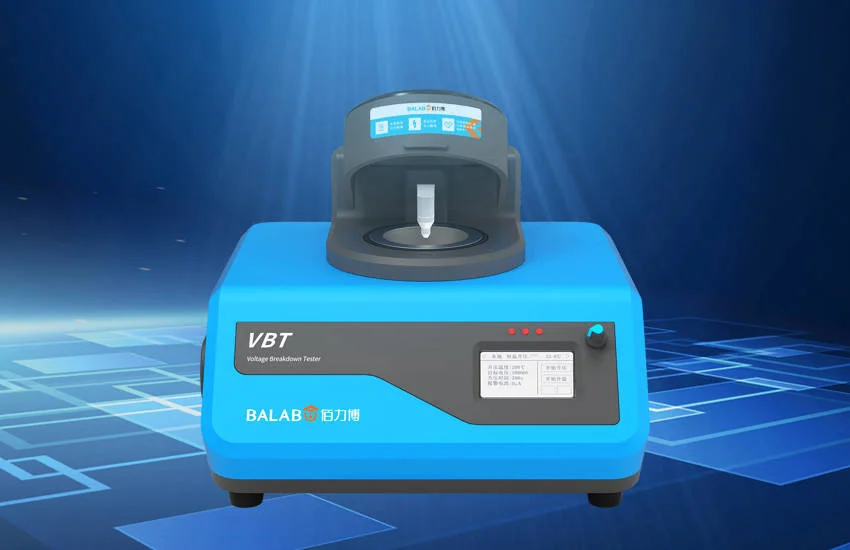
The MatMeas VBT-30kV Voltage Breakdown Tester provides digital high-voltage generation and automated dielectric strength evaluation for piezoelectric ceramics, substrates, and functional dielectrics.
Key technical specifications of the VBT-30kV include:
- Digital High-Voltage Output (0 to 30 kV): Provides continuously programmable DC test voltages up to 30 kV with fine resolution and controllable ramp rates (<5 kV/s).
- Integrated Silicone Oil Bath: Built-in oil bath fixture eliminates edge flashover, enabling accurate measurement of intrinsic bulk dielectric strength.
- Thermal Regulation (Ambient to 180°C): Integrated PID heating allows researchers to record temperature-dependent breakdown curves and establish thermal derating limits.
- Fast Microsecond Interlock Protection: Shuts off high voltage within microseconds upon current threshold breach (adjustable from 10 μA to 20 mA), preserving specimen puncture morphology for scanning electron microscopy.
- Operator Safety Architecture: Features dual safety interlocks, automatic high-voltage discharge grounding, and a shielded test chamber for complete operator protection during 30 kV procedures.
Frequently Asked Questions
How does dielectric breakdown strength influence the maximum achieved piezoelectric d33 coefficient?
To maximize the piezoelectric charge coefficient d33, ferroelectric domains must achieve near-complete saturation. Aligning resistant non-180° domains requires applied poling fields 2 to 3 times the coercive field. A higher dielectric breakdown threshold provides a wider safety margin, allowing engineers to apply aggressive poling fields without risking catastrophic punch-through.
Why is an insulating silicone oil bath mandatory when testing piezoelectric breakdown?
In ambient air, the dielectric strength of air (~3 kV/mm) is far lower than that of dense piezoelectric ceramics (10 to 20 kV/mm). High electric field concentrations at the electrode perimeter ionize surrounding air, triggering a superficial surface flashover arc long before the ceramic reaches its intrinsic volume breakdown threshold. Immersing the specimen in silicone oil suppresses air ionization, isolating true bulk dielectric puncture.
What is the primary difference between continuous ramp testing and step withstand testing?
Continuous ramp testing increases voltage steadily (e.g., 500 V/s) until puncture occurs, measuring the absolute short-term dielectric strength. Step withstand testing holds the voltage at predetermined plateaus for specified durations (e.g., 1 minute per step) to evaluate time-dependent dielectric fatigue, partial discharge degradation, and production proof-voltage compliance.
Request High-Precision Testing Solutions
Get expert guidance and customized instruments for your functional materials project.