Ceramic Substrate Dielectric Temperature Spectroscopy Guide
Technical News
Ceramic substrates serve as critical structural and insulating platforms in electric vehicle traction inverters, aerospace turbine instrumentation, high-frequency radar modules, and downhole exploration electronics. In operating environments characterized by wide thermal excursions (-55°C to well above 500°C) and alternating electric fields, understanding the dielectric thermal stability of ceramic materials is paramount. Dielectric temperature spectroscopy provides the definitive diagnostic methodology, quantifying how real permittivity, capacitive thermal drift, and dielectric loss evolve under controlled thermal excitation.
In precision power modules and RF packaging, uncharacterized temperature-induced capacitance drift causes circuit detuning, phase distortion, and local thermal runaway. Evaluating the Temperature Coefficient of Capacitance (TCC) and Temperature Coefficient of Permittivity (TCε) enables materials scientists and packaging engineers to establish strict operational envelopes and guarantee high-temperature circuit stability.
Principles of Dielectric Temperature Spectroscopy and Thermal Drift
Dielectric temperature spectroscopy evaluates how microscopic polarization mechanisms within a ceramic matrix evolve under simultaneous frequency sweeps and thermal modulation, as detailed in our guide on broadband dielectric spectroscopy testing for ceramics:
- Energy Storage vs Dissipation: Real permittivity (
ε') reflects electrostatic energy storage capability, while the loss tangent (tan δ = ε'' / ε', characterized via ceramic substrate dielectric loss testing) quantifies the proportion of electrical energy converted into internal heat during polarization cycles. - Temperature Coefficient of Permittivity (TCε): Measures the fractional change in dielectric permittivity per degree Celsius relative to a reference temperature (typically 25°C):
TCε = ( 1 / ε_ref ) * ( dε / dT ) * 10^6 (ppm/K)
- Temperature Coefficient of Capacitance (TCC): In a parallel-plate substrate capacitor (
C = ε_0 * ε_r * A / t), thermal expansion alters specimen dimensions simultaneously with permittivity. The resulting capacitance drift combines TCε and the linear coefficient of thermal expansion (α_L):
TCC = ( 1 / C_ref ) * ( dC / dT ) * 10^6 = TCε + α_L (ppm/K)
where α_L = ( 1 / L ) * ( dL / dT ). In high-purity oxide ceramics, α_L typically contributes +5 to +10 ppm/K, meaning that intrinsic permittivity drift dominates the overall capacitive response.
- The Bosman-Havinga Clausius-Mossotti Derivation: The microscopic physical origin of TCε in non-ferroelectric ceramics is governed by the Bosman-Havinga formulation of the Clausius-Mossotti equation:
TCε = [ ( ε - 1 ) * ( ε + 2 ) / ( 3 * ε ) ] * [ ( 1 / α_m ) * ( dα_m / dT ) - 3 * α_L ]
where α_m is the macroscopic polarizability of constituent ions. Thermal lattice expansion increases volume, diluting polarizable atoms per unit volume (a negative contribution), whereas thermal expansion simultaneously increases ionic polarizability through anharmonic lattice vibrations (a positive contribution). In most technical ceramics, the polarizability increase outweighs volumetric dilution, producing a positive TCε.
Temperature Coefficient of Capacitance (TCC) Benchmark Across Power Substrates
Selecting substrates for high-temperature and power electronic packaging requires balancing dielectric permittivity, TCC stability, and thermal conductivity.
| Substrate Formulation | Material Grade / Description | Relative Permittivity εr (25°C, 1 MHz) | TCC (-55°C to 150°C) (ppm/K) | TCC (150°C to 500°C) (ppm/K) | Thermal Expansion α_L (ppm/K) | Thermal Conductivity k (W/m·K) | Primary High-Temperature Engineering Role |
|---|---|---|---|---|---|---|---|
| 96% Al2O3 | Standard Electronic DBC | 9.4 - 9.8 | +110 to +140 | +160 to +240 | 6.8 - 7.2 | 20 - 24 | Power semiconductor inverters, automotive control modules |
| 99.6% Al2O3 | Laser Thin-Film Grade | 9.8 - 10.0 | +90 to +120 | +130 to +180 | 7.0 - 7.4 | 28 - 32 | High-precision RF hybrid ICs, microwave satellite feeds |
| AlN (Aluminum Nitride) | High Thermal Purity | 8.6 - 9.0 | +70 to +95 | +100 to +150 | 4.5 - 4.7 | 170 - 200 | High-power SiC/GaN module packaging, laser submounts |
| Si3N4 (Silicon Nitride) | High Toughness AMB | 8.1 - 8.4 | +50 to +75 | +80 to +120 | 3.0 - 3.2 | 80 - 90 | High-stress EV traction inverters, wind turbine drives |
| ZTA | Zirconia Toughened Alumina | 10.5 - 11.2 | +140 to +180 | +220 to +320 | 7.5 - 8.2 | 22 - 26 | High-reliability DBC substrates with enhanced bending strength |
| Barium Titanate (BaTiO3) | Ferroelectric Perovskite | 1500 - 3500 | Non-linear (±15%) | > -5000 (Curie drop) | 9.5 - 11.0 | 3 - 6 | High-energy decoupling capacitors; unstable as substrate |
Silicon nitride (Si3N4) and aluminum nitride (AlN) exhibit remarkably low TCC drift (+50 to +95 ppm/K), making them the preferred substrates for high-temperature wide-bandgap SiC modules where capacitance stability prevents parasitic gate-driver oscillation.
EIA Dielectric Classification and Substrate Stability Standards
To standardize temperature stability in electronic assemblies, international specifications adapt the Electronic Industries Alliance (EIA-198) classification scheme to evaluate dielectric thermal drift.
| EIA Dielectric Class | Temperature Operating Range (°C) | Maximum Permitted Capacitance Drift (ΔC/C) | Maximum Dissipation Factor (tan δ) | Substrate & Component Analogy | Typical High-Power Role |
|---|---|---|---|---|---|
| Class I (C0G / NP0) | -55°C to +125°C | 0 ± 30 ppm/K | < 0.0010 (at 1 MHz) | Ultra-stable glass-ceramics, high-purity fused silica | Resonant tank circuits, RF matching filters |
| Class II (X7R) | -55°C to +125°C | ±15% relative to 25°C | < 0.0250 (at 1 kHz) | Modified ferroelectric titanate ceramics | Intermediate DC-bus decoupling, bypass filtering |
| Class II (X8R) | -55°C to +150°C | ±15% relative to 25°C | < 0.0300 (at 1 kHz) | High-temperature automotive MLCC dielectrics | Engine control modules, high-temperature power electronics |
| Class I Substrate (DBC/AMB) | -55°C to +500°C | Continuous linear drift (TCC < +200 ppm/K) | < 0.0050 (up to 300°C) | Dense AlN, Si3N4, and 99.6% Al2O3 substrate tiles | Direct bonded copper power modules, traction inverters |
Non-ferroelectric substrate materials (Al2O3, AlN, Si3N4) behave as superior Class I dielectrics across broad thermal sweeps, exhibiting smooth, predictable linear drift without the catastrophic hysteresis and Curie point collapse inherent to Class II ferroelectric ceramics.
Thermal Scanning Dynamics and Phase Transition Mapping
Mapping dielectric temperature spectra requires continuous, uniform thermal modulation within a sealed environmental chamber:
- Controlled Thermal Ramp Rates: Specimens are subjected to programmable heating and cooling cycles (typically 1 K/min to 3 K/min). Fast heating creates thermal gradients between sample surfaces and core, inducing spurious hysteresis between heating and cooling curves.
- Multi-Frequency Impedance Sweeps: At each temperature step, an impedance bridge sweeps across multiple frequency decades (e.g., 1 kHz, 10 kHz, 100 kHz, 1 MHz, 10 MHz). Comparing frequency dispersion identifies whether capacitance shifts stem from intrinsic lattice polarizability or thermally activated space-charge conduction.
- Oxygen Vacancy Activation: In technical ceramics, when temperatures exceed 400°C, oxygen vacancies and mobile intergranular ions gain sufficient kinetic energy to hop across grain boundaries. This thermal activation creates a pronounced rise in low-frequency dielectric loss, establishing the upper safe thermal operating limit.
Characterization Capabilities of the MatMeas DMS-1000
Evaluating dielectric constant dispersion, TCC curves, and thermal drift requires specialized metrology instrumentation combining wide frequency sweeps with precision environmental thermal control.
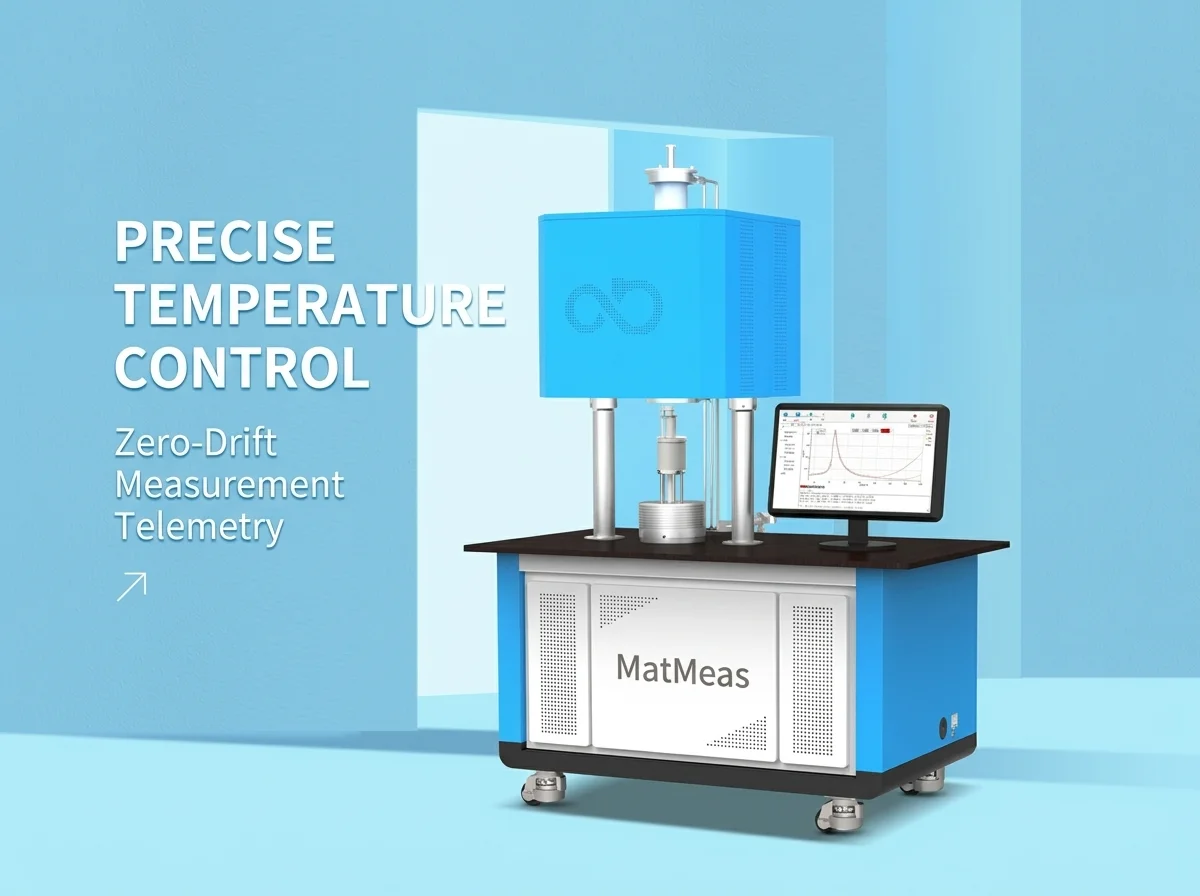
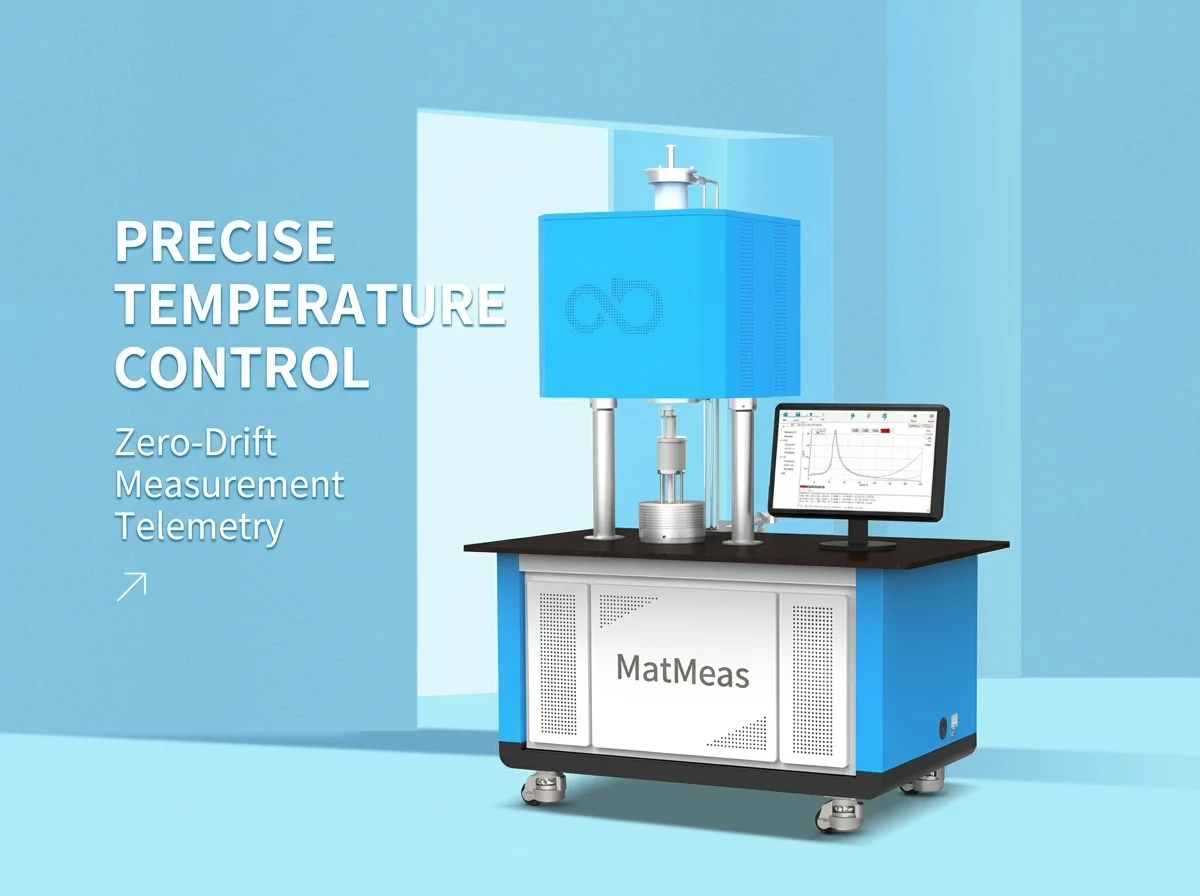
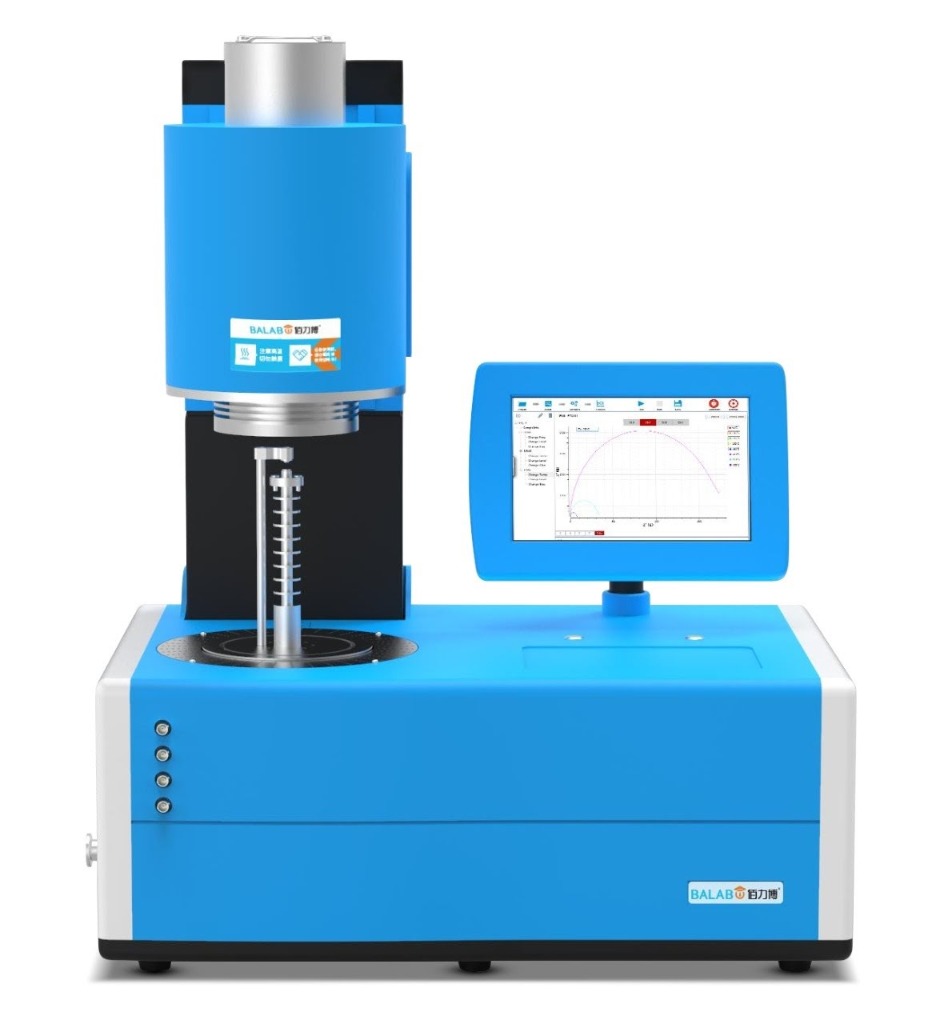
The MatMeas DMS-1000 high-temperature dielectric measurement system provides automated impedance and permittivity characterization across extreme thermal environments.
Key technical specifications of the DMS-1000 include:
- Broad Temperature Operating Range (Ambient to 1000°C): Features a high-stability furnace with digital PID temperature regulation achieving ±0.5°C stability, supporting liquid nitrogen cryogenic options down to -160°C.
- Wide Frequency Coverage (20 Hz to 30 MHz): High-resolution impedance testing with 0.05% basic measurement accuracy for broadband characterization.
- Multi-Atmosphere Capability: Operates in ambient air, flowing inert gases (nitrogen, argon), reducing mixtures, or high vacuum to replicate real industrial operating environments.
- Guarded Platinum Electrodes: High-purity platinum fixtures with calibrated mechanical contact force (max 0.25 N) maintain stable, non-oxidizing electrical contact up to 1000°C without sample microcracking.
- Automated TCC Parameter Extraction: Dedicated software records multi-frequency capacitance sweeps versus temperature, automatically computing TCε, TCC, and dielectric loss tangents.
Frequently Asked Questions
What is the fundamental difference between the Temperature Coefficient of Permittivity (TCε) and Temperature Coefficient of Capacitance (TCC)?
TCε represents the intrinsic change in material relative permittivity with temperature, normalized in ppm/K. TCC represents the change in actual component capacitance, combining the intrinsic permittivity drift (TCε) with dimensional thermal expansion (the linear thermal expansion coefficient α_L): TCC = TCε + α_L. Because physical thermal expansion increases electrode area and thickness, TCC accurately describes functional component drift in circuit hardware.
Why do non-ferroelectric ceramic substrates like AlN and Si3N4 display superior thermal stability over ferroelectric ceramics?
Non-ferroelectric ceramics (AlN, Si3N4, Al2O3) exhibit centrosymmetric crystalline structures without spontaneous electric dipoles. Their permittivity drift is governed solely by gradual lattice expansion and ionic polarizability, yielding smooth, linear TCC values (+50 to +140 ppm/K). Ferroelectric ceramics (such as BaTiO3) exhibit domain transitions with non-linear capacitance shifts exceeding ±15% and sharp permittivity collapse above their Curie point (as mapped through Curie temperature dielectric analysis and Cole-Cole plots).
How does heating ramp rate affect the accuracy of dielectric temperature spectroscopy?
Excessive heating rates (exceeding 5 K/min) induce thermal lag between the furnace thermocouple and the core of the ceramic specimen. This thermal lag causes artificial discrepancies between heating and cooling curves (thermal hysteresis) and shifts measured peak temperatures. Standard testing protocols recommend slow ramp rates (1 to 2 K/min) to guarantee thermal equilibrium throughout the specimen volume.
Request High-Precision Testing Solutions
Get expert guidance and customized instruments for your functional materials project.