Piezoelectric Polarization: Mechanisms and Metrology
Technical News
In modern electronic engineering and functional materials science, piezoelectric ceramics and electroactive polymers serve as fundamental electromechanical transducers, bridging the gap between mechanical force and electrical signals. From medical ultrasonic imaging probes and industrial acoustic emission sensors to precision nanopositioning stages and vibrational energy harvesters, these active materials underpin vital technologies. However, freshly sintered ferroelectric ceramics and synthesized polymer films exhibit zero net macroscopic piezoelectricity. To activate their functional electromechanical properties, materials must undergo a controlled electrical conditioning process termed polarization (or poling).
Without polarization, spontaneous electric dipoles within individual crystalline grains or polymer lamellae remain randomly oriented across crystallographic variants, canceling out macroscopic electrical responses. High-voltage poling reorients these ferroelectric domains along a defined external vector, establishing permanent remanent polarization that converts an otherwise centrosymmetric macroscopic ceramic into an active, responsive transducer.
The Physical Principles of Ferroelectric Domain Polarization
Ferroelectric materials possess spontaneous internal polarization below their Curie transition temperature (Tc). In unpoled polycrystalline ceramics—such as lead zirconate titanate (PZT) or lead-free potassium sodium niobate (KNN)—the orientation of spontaneous dipoles is disordered across neighboring domains and grains. Applying an external electric field that substantially exceeds the material's intrinsic coercive field (Ec) drives domain wall movement:
- 180° Domain Reversal: Domains whose spontaneous polarization vectors directly oppose the applied electric field flip 180° via low-energy nucleation and forward domain wall growth without inducing internal lattice shear strain.
- Non-180° Ferroelastic Domain Switching: Domains oriented at 90° (in tetragonal perovskite symmetry) or 71°/109° (in rhombohedral symmetry) rotate to align with the nearest crystallographic field vector. This non-180° reorientation generates massive anisotropic internal lattice strains (
c/a - 1) that contribute significantly to the extrinsic piezoelectric response. - Domain Switching Kinetics and the Merz Law: The velocity (
v) of propagating ferroelectric domain walls under an applied electric fieldEfollows the classical Merz empirical relation:
v = v_inf * exp( -α / E )
where v_inf represents acoustic limiting velocity and α is the characteristic activation field. To achieve domain saturation, the poling field E_pol must satisfy E_pol ≥ ( 2 to 3 ) * E_c.
- Remanent Polarization and Piezoelectric Response: Once domain saturation is achieved and the external field is removed, internal elastic clamping and defect dipoles prevent domains from randomizing, establishing a permanent remanent polarization (
P_r). The resulting small-signal longitudinal piezoelectric coefficientd_33is coupled to remanent polarization via the electrostrictive tensor:
d_33 = 2 * Q_11 * ε_0 * ε_r * P_r
where Q_11 is the longitudinal electrostrictive coefficient, ε_0 is vacuum permittivity (8.854 * 10^-12 F/m), and ε_r is the relative dielectric permittivity of the poled ceramic.
Polarization Modalities: Direct Current, Pulse, and Corona Poling
Selecting the optimal poling technique depends on specimen geometry, dielectric breakdown strength, conductivity, and electrode configuration.
| Poling Modality | Operating Principle | Applicable Specimen Geometries | Typical Applied Field | Electrode Requirement | Dielectric Puncture Risk | Primary Metrological Advantage |
|---|---|---|---|---|---|---|
| Direct Current (DC) Oil Bath | Continuous DC voltage applied across opposing faces in heated dielectric oil | Bulk ceramic discs, plates, tubes, rings (thickness 0.5 to 20 mm) | 2.0 to 5.0 kV/mm | Continuous conductive metallization on both major faces | High (catastrophic arc if pore or grain boundary breaks down) | Uniform field across thick bulk ceramics; reliable industrial batch processing |
| High-Voltage Pulsed Poling | Microsecond-to-millisecond high-amplitude unipolar or bipolar pulses | Thin ceramic plates, high-loss relaxor ceramics, MEMS elements | 3.0 to 8.0 kV/mm (Peak) | Screen-printed or sputtered metallic thin-film electrodes | Moderate (mitigated by short pulse duration) | Suppresses cumulative Joule heating; allows poling of lossy conductive formulations |
| Corona Discharge Poling | High-voltage needle or wire ionizes gas, depositing charge onto non-metallized surface | Free-standing polymer films (PVDF, P(VDF-TrFE)), electrospun webs | 50 to 150 MV/m (Internal) | Grounded bottom substrate only; top surface remains bare | Low (self-healing local discharge without destructive arc propagation) | Eliminates top electrode deposition; uniform non-contact charge deposition over large areas |
While DC oil-bath poling remains standard for bulk ceramics, thin polymer films are vulnerable to pinhole dielectric punch-through. Corona poling deposits a continuous sheet of surface ions, creating enormous internal electrostatic fields without requiring deposited metallic electrodes.
Ferroelectric Poling Process Windows Across Material Classes
Formulation adjustments drastically alter ferroelectric domain mobility, switching barriers, and operational limits. Acceptor dopants create defect dipoles that pin domain walls, requiring elevated temperatures and higher fields, whereas donor dopants lower coercive fields.
| Material Class | Typical Ceramic / Polymer Formulation | Curie Temperature Tc (°C) | Coercive Field Ec (kV/mm) | Recommended Poling Field Epol (kV/mm) | Recommended Bath Temp (°C) | Poling Dwell Time (min) | Typical Achieved d33 (pC/N) |
|---|---|---|---|---|---|---|---|
| Soft PZT | PZT-5A / PZT-5H (Donor-doped) | 190 - 365 | 0.9 - 1.2 | 2.5 - 3.5 | 110 - 130 | 15 - 25 | 400 - 650 |
| Hard PZT | PZT-4 / PZT-8 (Acceptor-doped) | 300 - 340 | 1.8 - 2.5 | 4.0 - 5.5 | 130 - 160 | 20 - 30 | 210 - 300 |
| Lead-Free Perovskite | (K,Na)NbO3-modified (KNN) | 380 - 420 | 1.2 - 1.6 | 3.5 - 5.0 | 120 - 150 | 15 - 30 | 200 - 320 |
| Lead-Free Bismuth | (Bi0.5Na0.5)TiO3-based (BNT) | 280 - 320 | 3.5 - 5.0 | 6.0 - 8.0 | 80 - 100 | 10 - 20 | 140 - 190 |
| Piezoelectric Polymer | PVDF / P(VDF-TrFE) Film | 130 - 150 | 40 - 60 (MV/m) | 80 - 120 (MV/m) | 80 - 110 | 10 - 20 | 25 - 35 |
| Layered Titanate | Bismuth Titanate (Bi4Ti3O12) | 650 - 675 | 3.0 - 4.5 | 6.0 - 10.0 | 180 - 220 | 20 - 40 | 15 - 25 |
Elevating temperature lowers the coercive field, allowing non-180° domain switching without requiring electric fields that exceed dielectric puncture thresholds. To avoid thermal depoling, the electric field must be maintained continuously while the oil bath cools below 40°C.
Process Optimization and Breakdown Mitigation
Achieving high electromechanical coupling while avoiding mechanical fracture or dielectric punch-through requires strict operational controls:
- Slow-Ramp Field Application: Applying a multi-kilovolt step voltage abruptly induces violent 90° ferroelastic switching. The sudden anisotropic lattice strain generates microcracks along grain boundaries. Programmable high-voltage supplies must ramp the electric field smoothly at rates between 100 V/s and 500 V/s.
- Dielectric Liquid Insulation: Poling in open air triggers atmospheric flashover at approximately 3 kV/mm. Submerging specimens in high-dielectric-strength methyl silicone oil eliminates edge corona and surface tracking.
- Current-Limit Tripping Protocols: Pre-breakdown avalanches produce localized micro-amperage surges. Modern polarization systems must integrate fast hardware interlocks that shut off voltage within microseconds when leakage current exceeds user-set thresholds.
Advanced Poling Platforms: MatMeas FCP and VBT Systems
High-yield materials research and pilot production require specialized instrumentation engineered to deliver stable field profiles and precise thermal management:
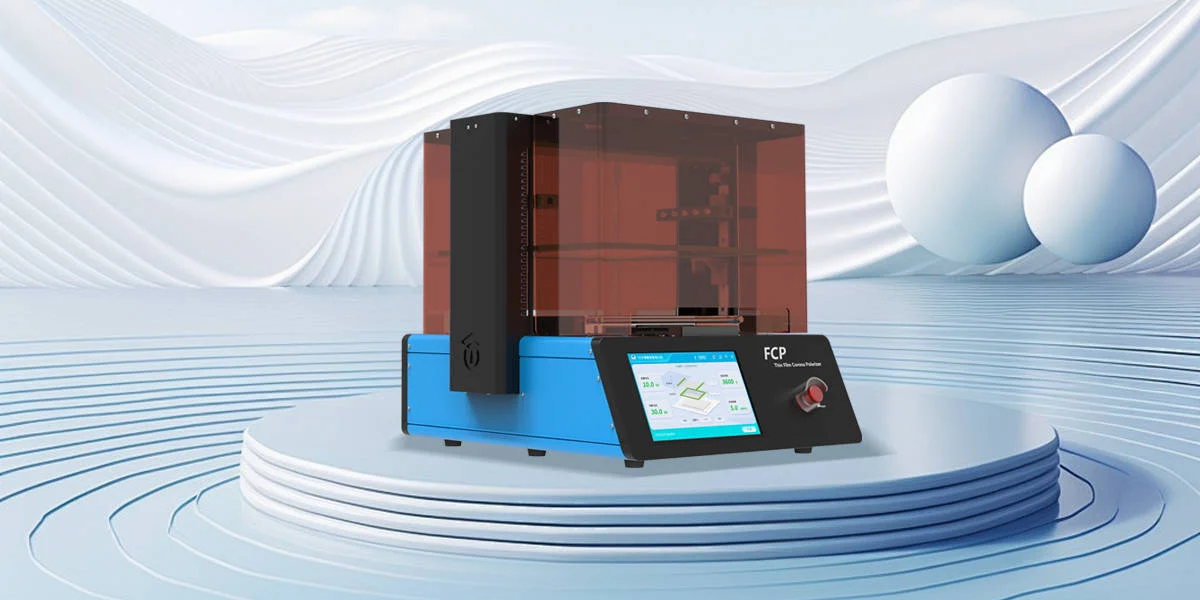
The MatMeas FCP Thin Film Corona Polarizer provides non-contact electrostatic poling specifically engineered for electroactive polymers, cellular ferroelectrics, and flexible piezo-composites up to A5 sheet format. Featuring dual independent high-voltage modules delivering up to 30 kV corona excitation, precise digital temperature control up to 180°C, and a fine wire grid, the FCP establishes uniform surface charge density without mechanical contact, preserving pristine film morphology.
For bulk ceramics, multi-layer stacks, and dielectric breakdown evaluation, the MatMeas VBT-30kV Voltage Breakdown Tester combines high-voltage dielectric strength testing and precision DC polarization. With programmable voltage ramp rates, integrated silicone oil bath heating, and microsecond-level overcurrent safety trips, the VBT-30kV allows researchers to map dielectric breakdown limits and determine exact poling windows with complete operational safety.
Frequently Asked Questions
Why must piezoelectric ceramics be poled at elevated temperatures in an oil bath?
Elevating the temperature toward the Curie point increases thermal energy within the crystal lattice, substantially lowering the coercive field (Ec) required to switch ferroelectric domains. Immersing the ceramic in high-purity silicone oil suppresses surface electrical flashover in air and guarantees uniform temperature distribution across the sample.
How does corona discharge poling prevent catastrophic punch-through in thin polymer films?
In conventional contact poling, continuous metal electrodes act as equipotential planes; a localized microstructural pinhole causes the entire electrode charge to dump into a destructive short-circuit arc. In corona poling, ions are sprayed electrostatically across the bare film surface. If a pinhole occurs, only the microscopic charge directly above the defect dissipates, leaving the surrounding film area fully polarized without catastrophic arc propagation.
Why is it essential to maintain the electric field during the cooling phase of poling?
Domain switching involves overcoming an energetic barrier. When domains align at elevated temperatures, thermal fluctuations remain elevated. Removing the electric field while the material is still hot allows thermal agitation to re-randomize non-180° domains back into low-strain configurations. Maintaining the field until the bath cools below 40°C locks aligned domains securely into the crystal lattice, maximizing remanent polarization and d33.
Related Instruments & Equipment
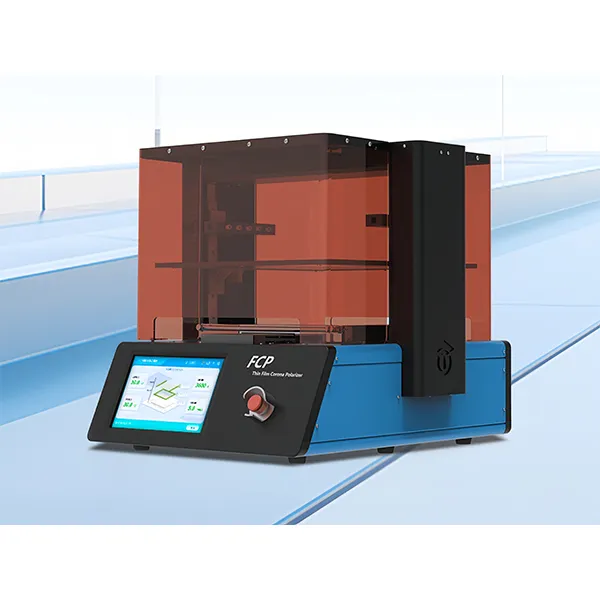
MatMeas FCP Thin Film Corona Polarizer
The MatMeas FCP Thin Film Corona Polarizer is an advanced laboratory platform specifically engineered for high-efficiency polarization of piezoelectric polymer films (e.g., PVDF, P(VDF-TrFE)). Delivering 0 to −30 kV / 2 mA negative corona discharge across a spacious 200 mm × 200 mm active poling area, it features dual independent power modules to eliminate electrical cross-talk and utilizes an innovative non-contact single-wire electrode fixture. With optional FCPHT150 high-temperature heating stage (≤ 150°C, precision ≤ ±3°C) and FCPOP01 smart suite supporting remote OTA updates and API integration, the FCP uniformly polarizes ultra-thin films (5 μm to 200 μm, ideally 10–50 μm) from custom coupons (e.g., 50 mm × 50 mm) up to 200 mm × 200 mm sheets without dielectric breakdown.
View details →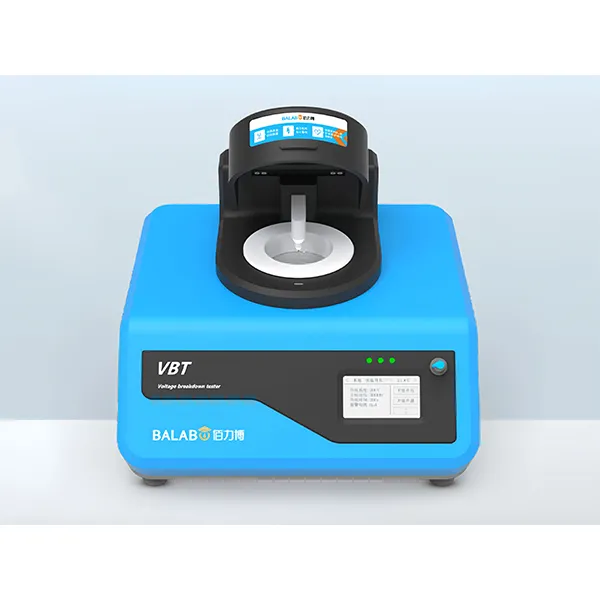
VBT-30KV Voltage Breakdown Tester
The MatMeas VBT-30KV (VBT30KVPOS) is a highly specialized Voltage Breakdown Tester engineered to rigorously evaluate the dielectric strength of piezoelectric ceramics. Powered by a highly accurate, compact 30kV digital high-voltage generator, it accurately determines both the maximum breakdown failure voltage and the maximum safe operating voltage. To ensure unparalleled operator safety and prevent surface flashover, the system conducts measurements within a temperature-controlled silicone oil environment (RT to 180°C) and integrates proprietary high-voltage interlock breakdown isolation technology. With versatile step-up modes including uniform speed breakdown and withstand voltage modes, it is an indispensable reliability verification tool for research institutes and advanced manufacturing enterprises.
View details →Request High-Precision Testing Solutions
Get expert guidance and customized instruments for your functional materials project.