Understanding Piezoelectric Coefficients: A Guide to d33, d31, and d15
Technical News
Piezoelectric materials—comprising polycrystalline perovskite ceramics (such as lead zirconate titanate PZT and potassium sodium niobate KNN), ferroelectric single crystals (such as PMN-PT), and polar polymers—form the electromechanical foundation of ultrasonic acoustic transducers, precision micro-positioning stages, sonar arrays, and vibration energy harvesters. These functional materials are defined by their capacity to couple mechanical stress with electrical displacement reversibly.
However, piezoelectricity is not an isotropic scalar value; it is fundamentally an anisotropic, third-order tensor property. A single material exhibits radically divergent charge outputs, mechanical deformations, and resonance behaviors depending on the spatial orientation of applied mechanical forces relative to its internal macroscopic polarization axis. In device design and material metrology, three tensor coefficients dominate acoustic and sensor engineering: the longitudinal coefficient (d33), the transverse length-extensional coefficient (d31), and the thickness-shear coefficient (d15).
Correctly measuring, interpreting, and applying these tensor coefficients requires rigorous adherence to standardized crystallographic conventions, defined specimen aspect ratios, and resonance extraction algorithms established under IEEE Std 176 and IEC 60483 protocols.
Tensor Mechanics and the Piezoelectric Constitutive Equations
Under small-signal linear conditions, the electromechanical behavior of a piezoelectric solid is formulated through coupled thermodynamic constitutive relations. In the standard Voigt compressed notation (where tensor stress and strain subscripts 11, 22, 33, 23, 13, and 12 are condensed into indices 1 through 6):
- Direct Piezoelectric Effect (Sensor Equation):
D_i = d_ij * T_j + ε_ik^T * E_k - Converse Piezoelectric Effect (Actuator Equation):
S_i = s_ij^E * T_j + d_ki * E_k
where:
D_iis the dielectric displacement vector (C/m^2, i = 1, 2, 3).T_jis the mechanical stress tensor (N/m^2 or Pa, j = 1, 2, 3, 4, 5, 6).S_iis the dimensionless mechanical strain tensor.E_kis the applied electric field vector (V/m).s_ij^Eis the elastic compliance tensor measured under constant electric field (m^2/N).ε_ik^Tis the dielectric permittivity tensor measured under constant stress (F/m).d_ijis the piezoelectric charge coefficient matrix (expressed equivalently as C/N for the direct effect, or m/V for the converse effect).
By universal convention, a poled polycrystalline ceramic possesses transverse isotropic symmetry (Curie group ∞mm, equivalent to crystallographic point group 6mm). The macroscopic polarization vector is conventionally assigned strictly along the direction 3 (Z-axis), with directions 1 (X) and 2 (Y) forming the orthogonal isotropic plane. Under this symmetry, the non-zero piezoelectric charge coefficients reduce to just three independent matrix components: d33, d31 (where d32 = d31), and d15 (where d24 = d15).
Piezoelectric Matrix Structure for Poled Ceramics (Point Group 6mm):
     [  0    0    0    0   d15   0  ]
d =  [  0    0    0   d15   0    0  ]
     [ d31  d31  d33   0    0    0  ]
Longitudinal Coefficient (d33): Compression and Piston Mode
The longitudinal piezoelectric coefficient d33 quantifies electrical charge generated per unit force applied parallel to the poling axis (direction 3), with charge collected on electroded faces perpendicular to that same axis:
D_3 = d_33 * T_3 (Direct Effect)
S_3 = d_33 * E_3 (Converse Effect)
Because the mechanical stress, electric field, and polarization vectors are completely collinear, d33 is the dominant parameter for multilayer stack actuators, high-intensity focused ultrasound (HIFU) transmitters, and automotive fuel injectors. In perovskite ceramics, d33 is positive, indicating that compressive stress along direction 3 discharges electrical polarity opposite to the original poling field.
Transverse Coefficient (d31): Lateral Extension and Bending
The transverse length-extensional coefficient d31 links mechanical stress applied in the lateral plane (direction 1 or 2) with charge developed across the top and bottom electroded faces along direction 3:
D_3 = d_31 * T_1 (Direct Effect)
S_1 = d_31 * E_3 (Converse Effect)
In almost all perovskite ceramics, d31 possesses an algebraic sign opposite to d33 (i.e., d31 is negative). When an electric field is applied along the poling axis (+E3), the ceramic expands longitudinally (+S3 via d33) while simultaneously contracting laterally (-S1 via d31) due to volume-conserving Poisson coupling. The transverse mode is utilized in bimorph/unimorph bending cantilevers, acoustic tone buzzers, and energy-harvesting diaphragms, where mechanical lever arms amplify minute lateral strains into large out-of-plane deflections.
For underwater acoustic hydrophones and hydrostatic pressure sensors, ambient hydrostatic pressure applies omnidirectional stress (T_1 = T_2 = T_3 = -p). The resulting hydrostatic charge coefficient d_h is the sum of all three active components:
d_h = d_33 + d_31 + d_32 = d_33 + 2 * d_31
Because d31 is negative and typically equals 40% to 50% of d33, the terms partially cancel out. Maximizing the hydrostatic figure of merit d_h * g_h requires material engineering to suppress |d31| while preserving high d33.
Thickness-Shear Coefficient (d15): Torsional and Shear Waves
The thickness-shear coefficient d15 describes electrical displacement generated perpendicular to the poling axis (direction 1) when a mechanical shear stress T_5 (acting in the 1-3 plane) is applied:
D_1 = d_15 * T_5 (Direct Effect)
S_5 = d_15 * E_1 (Converse Effect)
In ferroelectric perovskites, d15 is almost universally the largest piezoelectric coefficient, frequently 50% to 100% larger than d33. This massive shear response arises from facile transverse polarization rotation: rotating the spontaneous polarization vector away from the c-axis requires significantly lower free energy than stretching or compressing the dipole along its polar axis.
The d15 mode is deployed in non-destructive testing (NDT) shear-wave probes, structural health monitoring acoustic emission sensors, gyroscopic angular rate sensors, and torsional ultrasonic surgical scalpels.
| Piezoelectric Coefficient | Active Vibration Mode | Stress Axis vs. Charge Collection Axis | Specimen Geometry Specification (IEEE Std 176) | Recommended Aspect Ratio | Fundamental Resonant Frequency Formula | Standard Measurement Methodology |
|---|---|---|---|---|---|---|
| d33 (Longitudinal) | Length extensional rod / Piston mode | Stress along Z (3); Charge collected on Z (3) | Slender rectangular bar or tall cylinder | Length / Width ≥ 3:1 (avoids lateral clamping) | f_r = ( 1 / 2L ) * sqrt( 1 / ( ρ * s33_D ) ) | Quasi-static Berlincourt or impedance resonance |
| d31 (Transverse) | Lateral extensional bar mode | Stress along X (1); Charge collected on Z (3) | Long, thin rectangular bar | Length / Width ≥ 5:1; Width / Thickness ≥ 3:1 | f_r = ( 1 / 2L ) * sqrt( 1 / ( ρ * s11_E ) ) | Dynamic complex impedance spectroscopy |
| d15 (Thickness Shear) | Thickness shear plate mode | Shear stress in X-Z (5); Charge on X (1) | Thin rectangular plate poled along length | Length & Width / Thickness ≥ 10:1 | f_r = ( 1 / 2t ) * sqrt( c44_D / ρ ) | Transverse resonance impedance extraction |
| dh (Hydrostatic) | Volumetric hydrostatic mode | Omnidirectional pressure; Charge on Z (3) | Unconstrained disk or encapsulated cylinder | Standard disc geometry | Quasi-static pressure cycle | Dynamic acoustic pressure comparison |
| Material Class / System | Dominant Crystal Symmetry | Longitudinal d33 (pC/N) | Transverse d31 (pC/N) | Thickness Shear d15 (pC/N) | Longitudinal Coupling k33 | Transverse Coupling k31 | Shear Coupling k15 | Curie Temp Tc (°C) |
|---|---|---|---|---|---|---|---|---|
| PZT-4 (Hard Transducer) | Tetragonal Perovskite | 285 - 320 | -120 - -135 | 450 - 500 | 0.70 | 0.33 | 0.71 | 328 |
| PZT-5A (Soft Sensor Grade) | Morphotropic Perovskite | 370 - 430 | -170 - -190 | 580 - 650 | 0.71 | 0.35 | 0.72 | 365 |
| PZT-5H (High-Sensitivity) | Soft Donor-Doped PZT | 580 - 680 | -260 - -310 | 750 - 900 | 0.75 | 0.39 | 0.76 | 195 |
| PMN-0.30PT (Relaxor Crystal) | Rhombohedral Single Crystal | 1,800 - 2,500 | -900 - -1,300 | 2,000 - 4,000 | 0.92 - 0.94 | 0.55 - 0.62 | 0.90 - 0.95 | 145 |
| BaTiO3 (Lead-Free Reference) | Tetragonal Perovskite | 190 - 220 | -75 - -90 | 260 - 300 | 0.50 | 0.21 | 0.48 | 125 |
| KNN Ceramic (Lead-Free) | Modified Orthorhombic | 300 - 420 | -120 - -160 | 450 - 600 | 0.68 | 0.31 | 0.65 | 410 |
Metrological Characterization: Quasi-Static vs. Dynamic Resonance Extraction
Accurate experimental extraction of d33, d31, and d15 requires selecting the appropriate metrology based on application demands and operational boundary conditions:
1. The Quasi-Static Berlincourt Method (Direct d33)
Direct quasi-static measurement applies an oscillating mechanical force F(t) = F_static + F_dyn * sin(ω*t) at low frequencies (typically 110 Hz) across the sample thickness. A reference piezoelectric standard connected in electrical and mechanical series generates a known charge Q_ref. By measuring the ratio of charges:
d33_sample = d33_ref * ( Q_sample / Q_ref )
The MatMeas PEAI-1000 high-precision piezoelectric analyzer provides a dedicated platform for quasi-static d33 characterization. Utilizing state-of-the-art lock-in amplification and calibrated static clamping forces (1 N to 10 N), the PEAI-1000 eliminates probe micro-bouncing and delivers rapid, repeatable d33 screening across production batches.
2. Full-Tensor Dynamic Resonance Spectroscopy (IEEE Std 176)
While the Berlincourt method is ideal for rapid longitudinal screening, extracting d31, d15, and full elastic compliances requires complex impedance resonance spectroscopy. In accordance with IEEE Std 176, the MatMeas PCA-1000 piezoelectric characterization analyzer sweeps frequency across fundamental resonant (fr) and anti-resonant (fa) peaks.
For a transverse bar resonator, the transverse coupling coefficient k31 is extracted from the transcendental resonance relation:
[ k31^2 / ( 1 - k31^2 ) ] = ( π / 2 ) * ( fa / fr ) * tan[ ( π / 2 ) * ( ( fa - fr ) / fa ) ]
From k31, the transverse charge coefficient d31 is calculated:
d31 = k31 * sqrt( ε33_T * s11_E )
Simultaneously, evaluating shear plates poled in-plane and driven across thickness yields k15 and d15 with sub-picocoulomb accuracy.
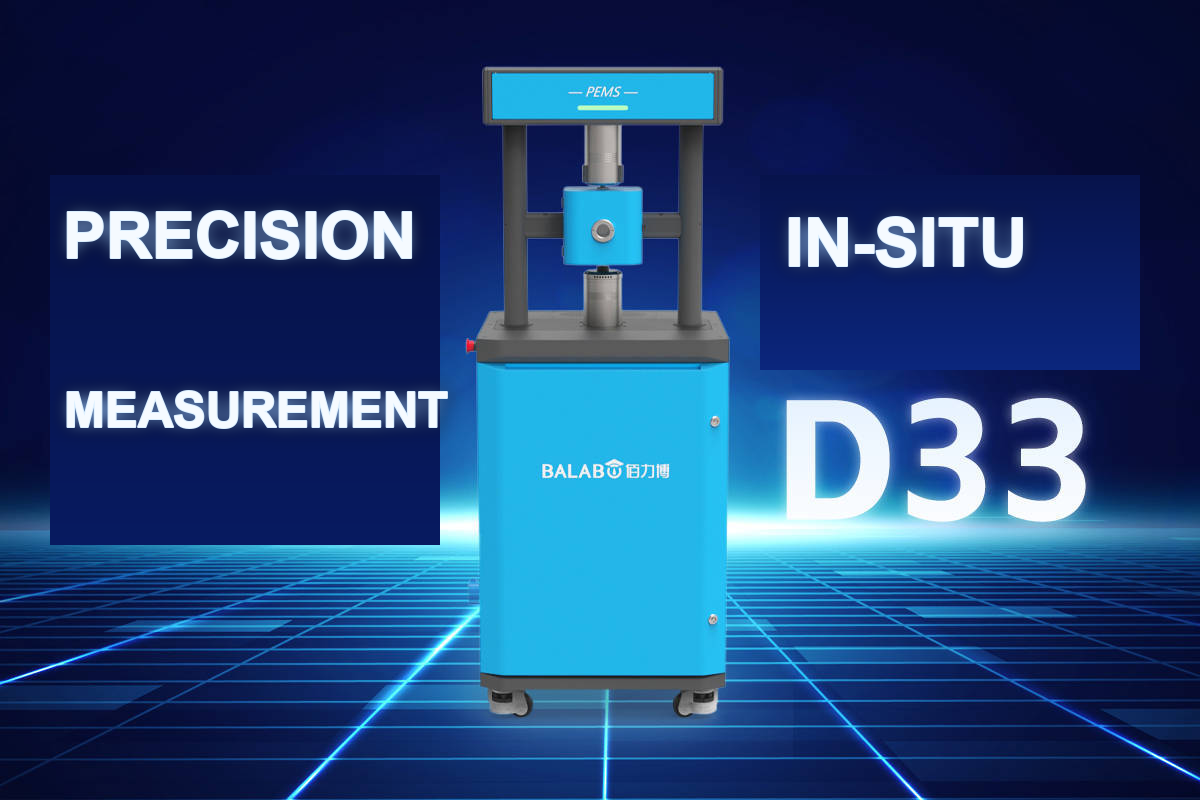
To evaluate dynamic coefficient retention under real-world thermal and mechanical stress, the MatMeas PEMS-1000 in-situ measurement system combines wide-frequency dynamic loading (30 Hz to 300 Hz) with closed-loop thermal control, capturing in-situ d33 degradation across mission-critical operating envelopes.
FAQ
Q: Why is the thickness-shear coefficient d15 usually much larger than the longitudinal d33?
A: In ferroelectric perovskites like PZT, d33 involves stretching or compressing the spontaneous polarization dipole along its polar c-axis, which requires overcoming significant lattice Coulomb energy. In contrast, d15 involves rotating the polarization vector transversely away from the polar axis (polarization rotation). The thermodynamic energy barrier for dipole tilting is substantially lower than for longitudinal stretching, resulting in massive shear compliance and exceptionally high d15 values.
Q: Why do aspect ratio constraints matter when machining specimens for IEEE resonance testing?
A: Standard 1D analytical resonance equations assume pure, uncoupled vibration modes. If a longitudinal bar has an aspect ratio below 3:1, lateral inertial clamping couples the length-extensional mode with radial thickness vibrations. This multi-dimensional modal coupling splits the resonance peak and corrupts parameter extraction. Maintaining length-to-width ratios above 3:1 for rods and 5:1 for transverse bars ensures that pure 1D plane-wave propagation dominates.
Q: What causes the sign difference between d33 and d31 in piezoelectric ceramics?
A: In polycrystalline ceramics, the Poisson ratio dictates that when a material is stretched along its longitudinal axis under an electric field (+S3 via d33), it contracts laterally (-S1 and -S2). Because transverse contraction produces opposite mechanical displacement for a given field direction, the transverse coefficient d31 is mathematically and physically negative, counteracting d33 during hydrostatic pressure loading.
Related Instruments & Equipment
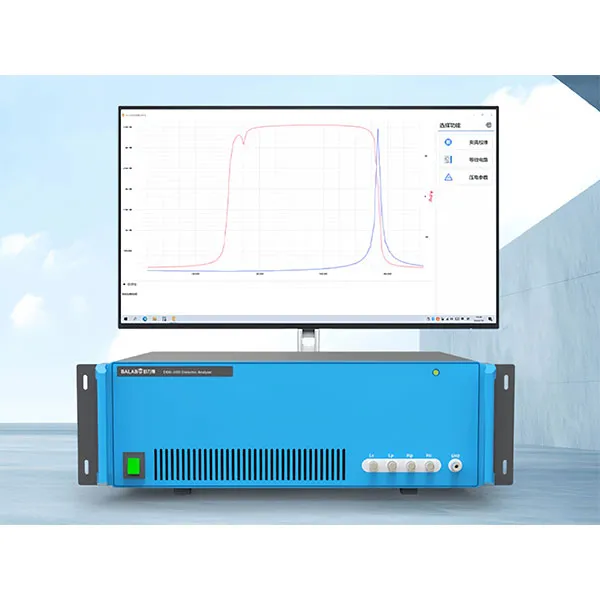
MatMeas High Precision Piezoelectric Ceramic Parameter Analyzer PCA1000
The MatMeas PCA1000 is a domestic-first, cutting-edge Piezoelectric Ceramic Integrated Analyzer engineered to comprehensively evaluate the performance of piezoelectric materials using the advanced AC resonance method. Operating across a wide frequency range from 20Hz to 10MHz with a high measurement accuracy of ±0.05%, it eliminates complex manual calculations by instantly extracting critical data, including electromechanical coupling coefficients (Kp, Kt), mechanical quality factors (Qm), piezoelectric constants (d33, d31, d15), and equivalent circuit models. With intelligent frequency sweeping and visualized data interfaces, the PCA1000 is the ultimate one-stop solution for both rigorous academic research and high-throughput quality screening in industrial mass production.
View details →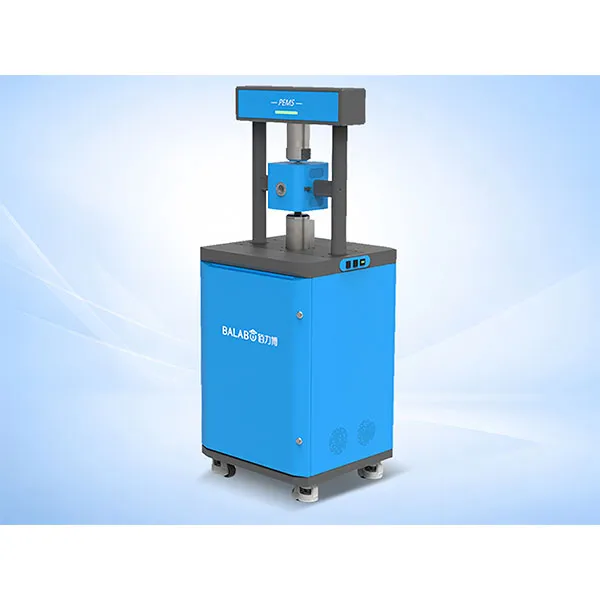
MatMeas High Precision In‑situ d33 Piezoelectric Measurement System – PEMS Analyzer
MatMeas PEMS is a high‑precision in‑situ d33 piezoelectric measurement system for advanced material characterization.
View details →
MatMeas PEAI1000 High-Precision Piezoelectric Analyzer
The MatMeas PEAI1000 is a next-generation High-Precision Piezoelectric Analyzer engineered to evaluate the piezoelectric coefficient (d33) of advanced functional materials. Surpassing the limitations of traditional d33 measuring instruments, it employs an advanced dynamic measurement method integrated with cutting-edge lock-in amplification technology. This architecture strictly suppresses environmental noise, significantly improving the signal-to-noise ratio. Capable of applying variable static clamping forces (1~10N) and precise dynamic test forces (0.1~0.5N), it guarantees an ultra-wide measurement range (0 to 2000 pC/N) with an exceptional accuracy of ±2%. It is an essential, highly reliable tool for the research, application, and mass production of piezoelectric blocks, plates, and delicate thin films.
View details →Request High-Precision Testing Solutions
Get expert guidance and customized instruments for your functional materials project.