Vacuum Flame-Sealing Narrow-Bore Quartz Tubes (2–5 mm) for EPR Spectroscopy
Technical News
Electron Paramagnetic Resonance (EPR) spectroscopy — also referred to as Electron Spin Resonance (ESR) — is the definitive analytical technique for probing chemical systems with unpaired electrons, including organic free radicals, transition metal complexes, and defect states in semiconductors. However, obtaining high-resolution, publication-grade EPR spectra requires rigorous sample preparation. The presence of atmospheric molecular oxygen (O₂) is notoriously detrimental: because ground-state oxygen is paramagnetic (S = 1), spin-spin dipole interactions and Heisenberg spin exchange cause severe spectral line broadening, obscuring the delicate hyperfine coupling constants that identify molecular spin centers.
Consequently, air-sensitive radicals, metal-organic coordination polymers, and reaction intermediates must be hermetically encapsulated in high-purity synthetic quartz (Suprasil) ampoules under vacuum or controlled inert gas backfill.
While sealing standard-sized quartz tubes (outer diameter 13 mm to 45 mm) for solid-state crystal growth is well documented, vacuum-sealing small quartz tubes (2 mm, 3 mm, 4 mm, and 5 mm OD with wall thicknesses of 0.5 to 0.8 mm) introduces unique engineering hurdles, especially when handling volatile organic solutions. This guide details the physical constraints, vacuum pumping architectures, flame dynamics, and operating protocols required to achieve flawless, distortion-free seals.
1. Physical & Thermodynamic Constraints of Small Quartz Tubes
Standard laboratory ampoules offer sufficient wall rigidity to withstand manual torch sealing. In contrast, narrow-diameter quartz tubes behave as delicate thermal and mechanical systems requiring precise heat and motion control.
       Vacuum Port (KF Flange)
                │
                ▼
   ┌───────────────────────────┐  ◄── Dynamic Magnetic Fluid Rotary Chuck (0–35 rpm)
   │  Precision Quartz Collet  │
   └─────────────┬─────────────┘
                 │
                 │ Quartz Tube (OD 2–5 mm, Wall 0.5–0.8 mm)
                 │
          ═══════╡═══════  ◄── Controlled Flame Fusion (1100°C – 1200°C)
                 │             Uniform radial heating collapses wall concentrically
                 │
                 │ Necking / Hermetic Pinch-off Zone
                 │
                 │
   ┌─────────────┴─────────────┐
   │  Cryogenic / Liquid N₂   │  ◄── Prevents solvent vapor pressure buildup
   │       Cooling Bath        │
   │                           │
   │  [Organic Liquid Sample]  │
   └───────────────────────────┘
Quartz Tube Wall Dynamics vs. Internal Vapor Blowout
In laboratory quartz sealing workflows, the working fusion temperature is maintained at 1100°C to 1200°C. When a flame strikes a stationary 3 mm tube with a 0.5 mm wall under vacuum:
- Asymmetrical Wall Collapse: Manual hand rotation is inherently irregular. The side facing the torch softens first; the external atmospheric pressure (101.3 kPa) immediately pushes the molten quartz inward, creating an asymmetrical wall depression that pinches the tube lumen unevenly.
- Thermal Shock & Pinholes: Uneven wall thickness results in localized stress concentrations upon cooling, frequently leading to micro-fractures, helium permeability, or tube fracture inside the EPR resonator cavity.
- Internal Pressure Blowout: If the sealed zone is heated while solvent vapor remains in the headspace, thermal expansion spikes internal pressure, blowing a bubble or pinhole through the softened quartz wall.
2. Pumping Station Architecture: Mechanical Pump vs. Turbomolecular Pumping Station
Researchers preparing EPR ampoules must balance vacuum level requirements against the chemical nature of the precursor. Choosing between a standard mechanical pump and a turbomolecular high-vacuum station depends on whether the sample is a dry powder or a volatile liquid.
| Technical Parameter | Mechanical Rotary Vane Configuration (Base: 10 Pa) | Turbomolecular Pumping Station (Base: 10⁻⁴ to 10⁻⁵ Pa) |
|---|---|---|
| Ultimate Vacuum Level | ≤ 10 Pa (0.1 mbar) | ≤ 10⁻⁴ to 10⁻⁵ Pa (10⁻⁶ to 10⁻⁷ mbar) |
| Pumping Mechanism | Heavy-duty dual-stage rotary vane pump | Multi-stage turbomolecular pump backed by mechanical diaphragm or rotary pump |
| Primary Sample Compatibility | Organic solutions, water mixtures, volatile liquid precursors, routine solid-state powders | Solid powder catalysts, single crystals, air-sensitive radicals, high-purity spin-labeled proteins |
| Volatile Solvent Resistance | High (with gas ballast and inline cold trap) | Low (volatile vapors condense on high-speed turbo blades, causing rotor drag and bearing wear) |
| Degassing Technique | Inline throttle valve + moderate vacuum evacuation | Multi-cycle Freeze-Pump-Thaw (FPT) + ultra-high vacuum pinch-off |
| Hydrocarbon Backstreaming Risk | Low-to-moderate (requires foreline oil mist filter or dry scroll backing) | Negligible (clean, hydrocarbon-free molecular flow) |
| Typical Target Application | Routine spin trapping, photochemical reaction monitoring, educational spectroscopy | Quantitative EPR, pulsed EPR/ENDOR, zero-field splitting studies, quantum coherence materials |
[!IMPORTANT] When sealing organic solutions, a mechanical pump (base vacuum 10 Pa) is the standard, battle-tested configuration. Opening an unthrottled high-vacuum turbomolecular pump directly to a liquid sample at room temperature will violently boil the solvent into the manifold and trigger turbo shutdown. Always pre-evacuate using a mechanical pump or isolate the sample using cryogenic freezing.
3. Handling Organic Compounds & Solutions: The Freeze-Pump-Thaw (FPT) Protocol
For solutions in organic solvents (toluene, THF, dichloromethane, ethanol) or deionized water, dissolved atmospheric oxygen must be removed without evaporating the liquid carrier.
[Step 1: Freeze] ────► [Step 2: Evacuate] ────► [Step 3: Thaw] ────► [Step 4: Seal]
Submerge in LN₂         Pull vacuum down to       Isolate vacuum;       Re-freeze under vacuum;
Solidify solvent         10 Pa                     Warm to room temp;    Ignite HHO torch and
matrix completely        Remove headspace O₂       Desorb trapped gases  execute dynamic rotary fusion
- Cryogenic Freezing (Step 1): Submerge the lower 30–50 mm of the quartz EPR tube into liquid nitrogen (-196°C) or an ethanol-dry ice slush (-78°C). Allow the entire solution volume to freeze completely into a solid block.
- Vacuum Evacuation (Step 2): Open the vacuum valve slowly. Evacuate the headspace over the frozen meniscus down to the base pressure (10 Pa with the mechanical pump).
- Thawing & Gas Desorption (Step 3): Close the vacuum isolation valve. Remove the tube from the cryogenic bath and allow the solvent to thaw slowly in an ambient water bath. Bubbles of dissolved gases (O₂, N₂) will vigorously desorb from the liquid phase into the headspace.
- Iterative Cycling (Step 4): Repeat the Freeze-Pump-Thaw sequence 3 to 4 times until no gas bubbles evolve during the thawing phase.
- Final Pinch-off (Step 5): Freeze the sample once more in liquid nitrogen, pump down to 10 Pa, and perform flame fusion at 1100°C – 1200°C while keeping the lower sample reservoir submerged in coolant to prevent radiant heat from boiling the solution.
4. Flame Chemistry: Water-Electrolysis HHO vs. Pressurized Bottled Gas
Traditional glassblowing uses bottled oxy-acetylene, propane, or LPG torches. In institutional research environments, high-pressure hydrocarbon gas cylinders present serious fire, explosion, and safety compliance issues.
Conventional Bottled Torches:
[Acetylene / LPG Cylinder] ──(High Pressure / Explosion Hazard)──► Carbon soot + Variable flame temperature

Water-Electrolysis (HHO) Technology:
[Deionized Water] ──(Electrolytic Cell)──► 2 H₂ + O₂ (On-Demand) ──► Clean Pinpoint Flame (Water Vapor Only)
The MatMeas Hydrogen Series HHO Flame Generator decomposes pure deionized water into stoichiometric hydrogen and oxygen gases on demand:
- Zero Pressurized Gas Storage: Flammable gas is produced only while the generator is energized, meeting stringent Environmental Health and Safety (EHS) regulations across North American, European, and Middle Eastern universities (such as NYUAD).
- Controlled Sealing Temperature (1100°C – 1200°C): The focused micro-torch delivers clean, pinpoint thermal energy, rapidly bringing the quartz tube wall to its optimal fusion temperature (1100°C – 1200°C) within seconds while restricting the heat-affected zone to prevent damage to sensitive organic compounds below.
- Zero Carbonaceous Contamination: Fusing with hydrocarbon gases can deposit microscopic carbon soot onto the quartz tube, which generates background spurious EPR resonance lines (g ≈ 2.0023). HHO flame combustion yields only ultra-pure water vapor.
5. Equipment Solution: The MatMeas MRVS-1003 Dynamic Rotary Sealer
The MatMeas MRVS-1003 High-Vacuum Rotary Sealing System is specifically engineered to resolve the mechanical instability of sealing small-diameter quartz ampoules:
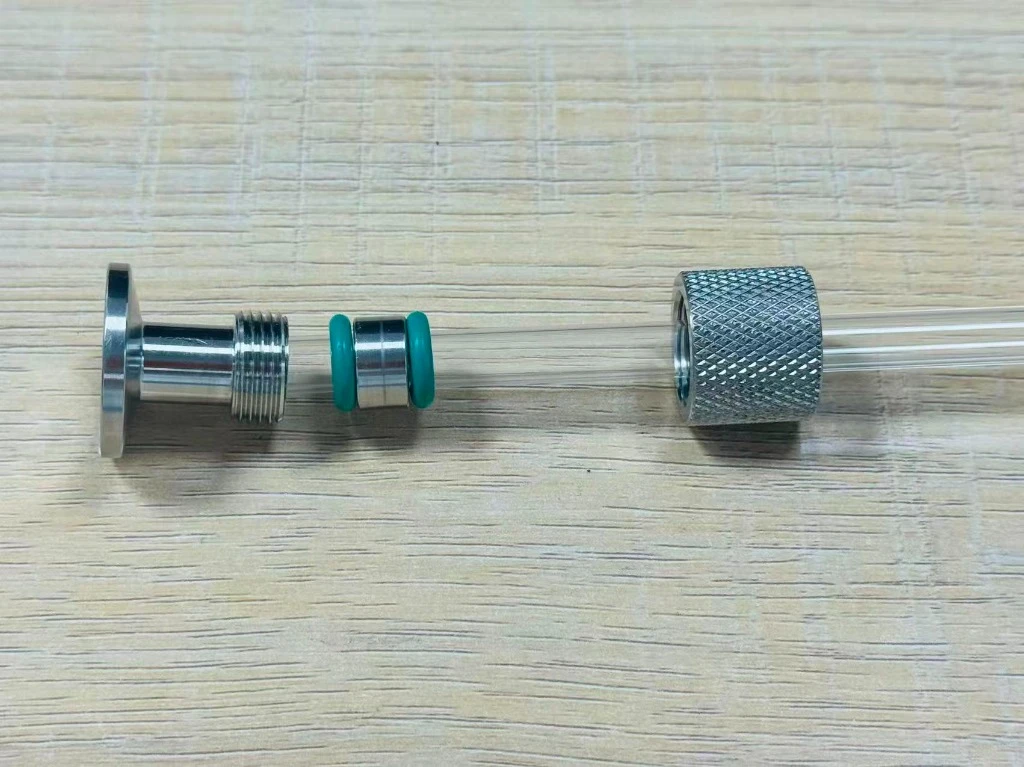
- Dynamic Magnetic Fluid Rotary Drive (0–35 rpm):
The quartz tube is clamped in a magnetic-fluid dynamic seal that rotates continuously throughout evacuation. Continuous motorized rotation distributes the flame heat across 360° of the tube circumference, ensuring that the 0.5–0.8 mm quartz wall softens concentrically at 1100°C – 1200°C and collapses into a solid, hermetic glass pinch. - Dedicated Quartz Tube Clamping Adapters:
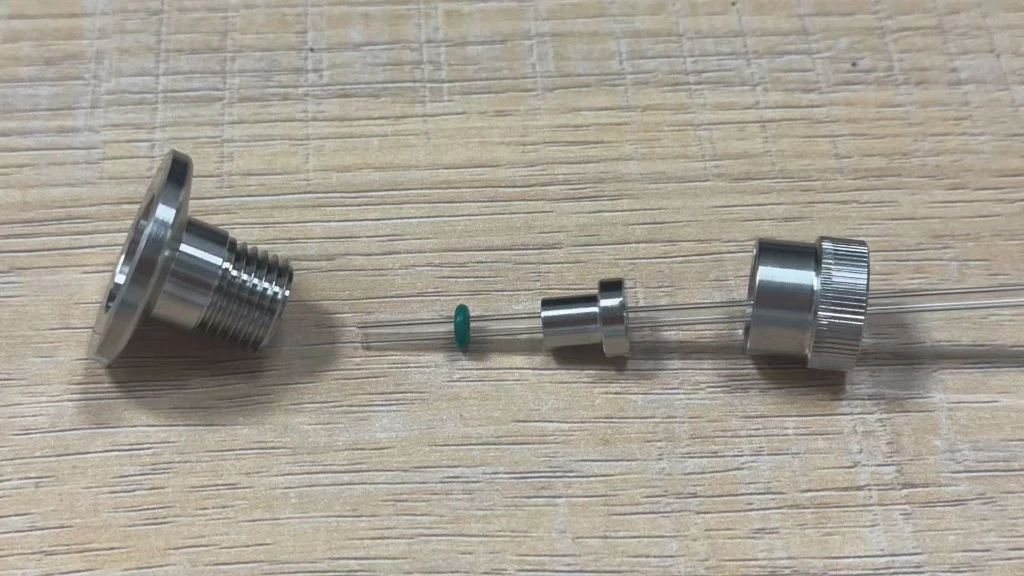
Standard vacuum chucks slip or crack small tubes. MatMeas supplies precision collet adapters specifically machined for 2 mm, 3 mm, 4 mm, and 5 mm outer diameter quartz tubes, holding tubes from 150 mm to 250 mm in length perfectly on-axis without angular wobble.
- Multi-Axis Tilting & Height Adjustment:
The entire sealing head tilts by up to 20° and slides vertically on a precision guide track. This allows operators to submerge the bottom of the tube in an LN₂ dewar flask while positioning the flame focal point precisely at the intended necking zone.
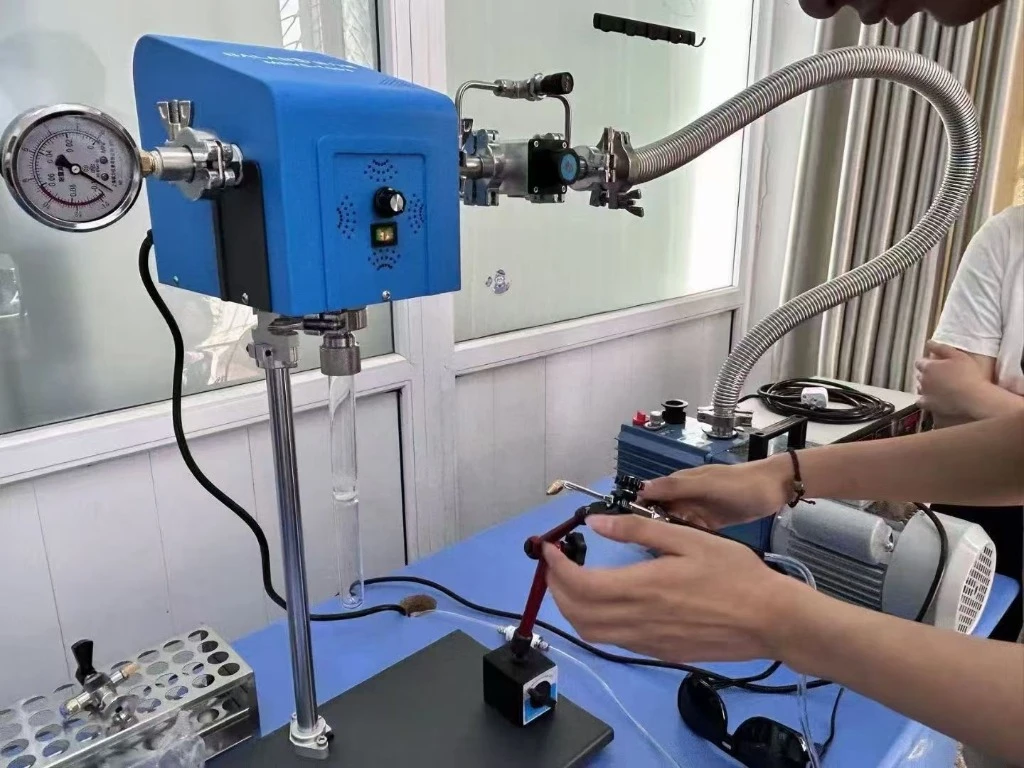
6. Standard Operating Procedure (SOP) for Sealing 2 mm to 5 mm Quartz Tubes
Step A: Tube Loading ──────► Step B: Evacuation & FPT ───► Step C: Rotary Fusion
Insert quartz tube into      Open throttle valve;          Engage 20 rpm rotation;
micro-collet; tighten        Run 3x Freeze-Pump-Thaw       Apply 1100°C–1200°C flame;
compression nut fingertight  down to 10 Pa base vacuum     Observe necking & draw off
Preparation
- Inspect the synthetic quartz EPR tube under polarized light or magnification to ensure the open lip is cut square and free of hairline fractures.
- Select the corresponding micro-collet (e.g., 2 mm, 3 mm, 4 mm, or 5 mm) and seat the fluororubber O-ring. Slide the open end of the tube into the MRVS-1003 rotary chuck until fully seated against the internal stop. Tighten the knurled compression nut fingertight.
Evacuation & Degassing
- If processing dry powder, ensure the inline Powder Anti-Reflux Kit (PAR16KIT) is connected to protect the mechanical vacuum pump.
- If processing organic liquids, immerse the tube bottom in liquid nitrogen. Slowly open the vacuum throttle valve.
- Monitor vacuum levels via the digital vacuum gauge until reaching ≤ 10 Pa with the rotary pump.
Flame Pinch-off
- Switch on the MRVS-1003 rotary drive and adjust the speed potentiometer to 15–25 rpm. Verify that the quartz tube rotates smoothly without eccentric vibration.
- Ignite the HHO flame torch. Adjust the micro-needle valve until the flame produces a narrow cone delivering a focused 1100°C – 1200°C working zone.
- Position the flame tip approximately 40–60 mm above the liquid meniscus (or 30 mm above a powder bed).
- As the rotating quartz softens, the wall will constrict inward under vacuum. Once the tube lumen closes completely, gently draw the lower dewar bracket downward to pull a smooth, tapered tip. Extinguish the flame immediately.
- Allow the sealed ampoule to cool in air for 2 minutes before dismounting from the rotary chuck. The sample is now hermetically sealed and ready for cryogenic or room-temperature EPR spectroscopy.
Summary
Sealing small 2 mm to 5 mm quartz ampoules for EPR spectroscopy demands tight control over thermal concentration, rotational symmetry, and vacuum degassing. By pairing the MatMeas MRVS-1003 dynamic rotary sealing platform with a 10 Pa mechanical vacuum pump and an on-demand HHO water-electrolysis flame generator, research laboratories achieve publication-quality hermetic seals, zero hydrocarbon background interference, and full compliance with international laboratory safety protocols.
For application notes, custom quartz tube tooling specifications, or official institutional quotations, explore our MRVS-1003 Product Overview or submit a technical inquiry through our portal.
Related Instruments & Equipment
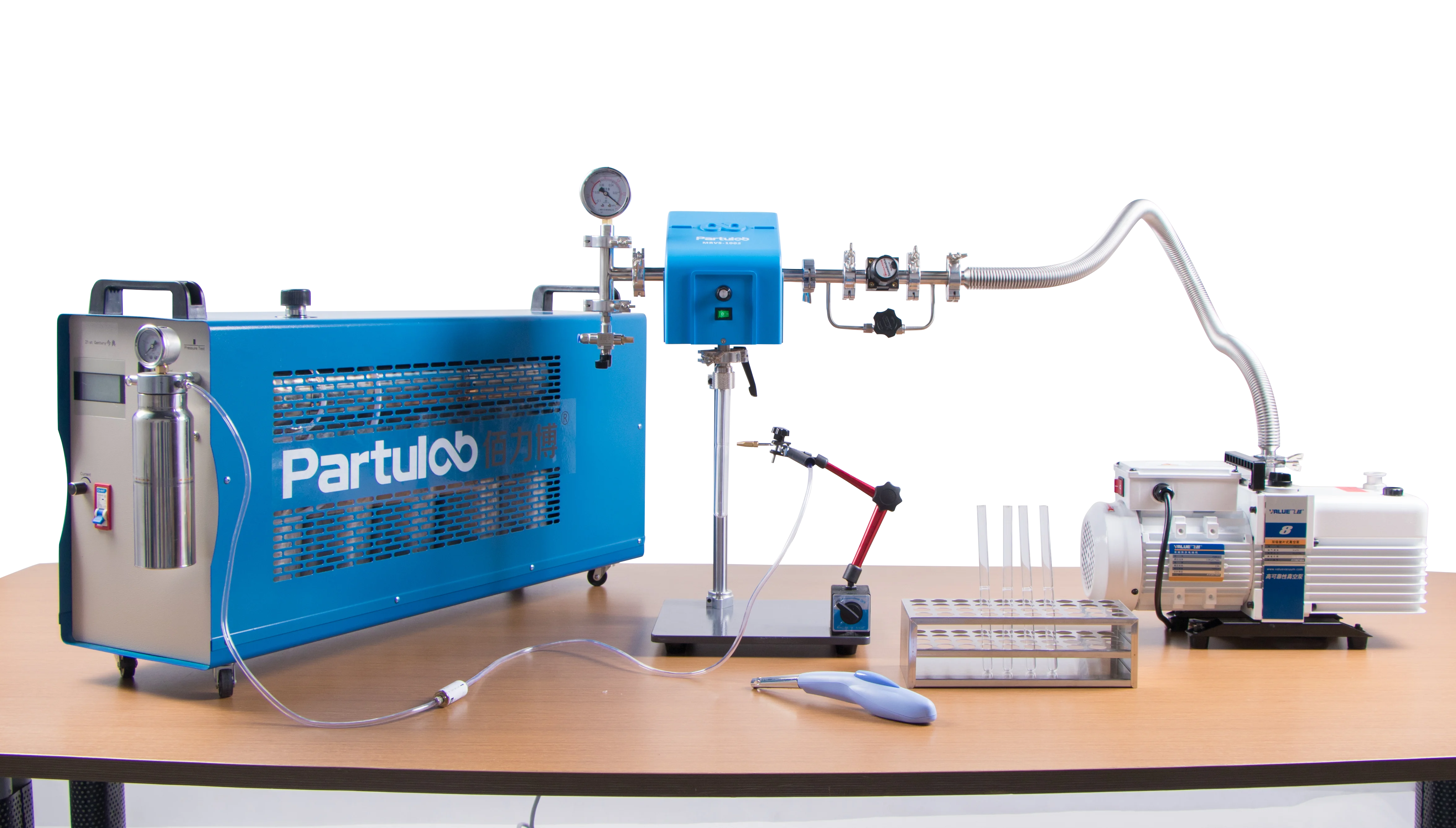
MRVS-1003 Vacuum Rotary Quartz Tube Sealing System
The MatMeas MRVS-1003 is an advanced single-station vacuum sealing machine engineered for the rigorous requirements of high-temperature solid-phase synthesis and oxygen-free/moisture-free sample preservation. Utilizing proprietary magnetic fluid dynamic sealing technology, it allows the quartz tube to rotate automatically at an adjustable speed of 0 to 35 rpm during the vacuuming process. Powered by an eco-friendly water electrolysis system generating a precise 2800℃ hydrogen-oxygen flame (700 L/H), and supporting an ultimate vacuum of up to 10⁻⁵ Pa via German-imported molecular pumps, it ensures perfectly uniform and reliable sealing for thermoelectric materials, 2D materials, and delicate powder samples.
View details →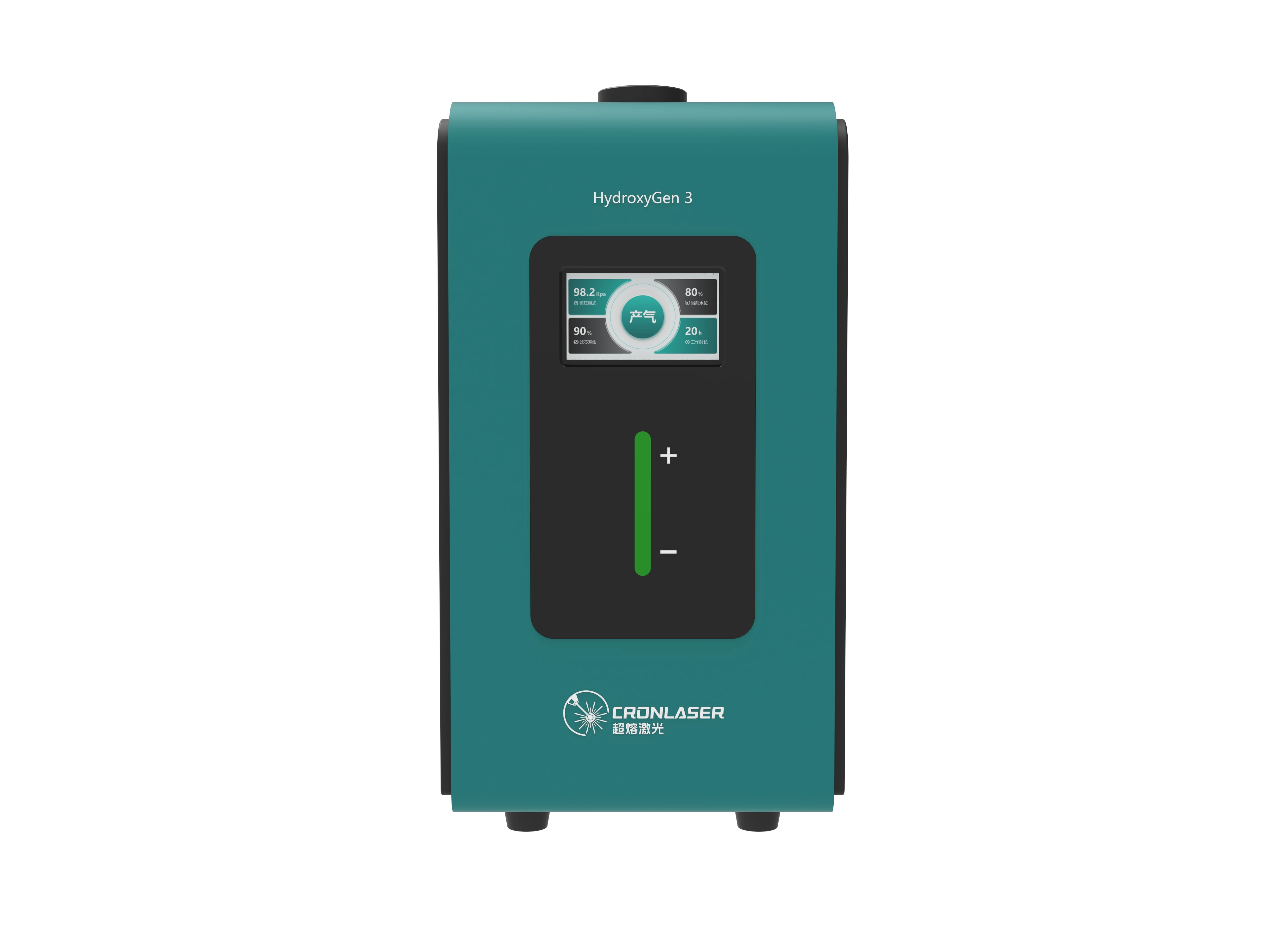
MatMeas HydroxyGen 3 Series Smart Hydrogen-Oxygen Flame Generator
The MatMeas HydroxyGen 3 Series is an industrial-grade, desktop smart hydrogen-oxygen flame generator built on PEM (Proton Exchange Membrane) pure water electrolysis technology. Requiring no hazardous alkaline chemicals whatsoever, it produces a continuous, ultra-pure (≥99.99%) hydrogen-oxygen gas mixture entirely on demand—generating and consuming gas instantaneously with millisecond-level responsiveness. Ignited automatically, the resulting micro-flame reaches temperatures of 2800°C to 3000°C, delivering a perfectly soot-free, contamination-free precision heat source for quartz tube sealing, flame polishing, micro-welding, Verneuil crystal growth, and gas-phase combustion synthesis. Its proprietary triple millisecond safety interlock system, IoT edge intelligence with OTA firmware updates, and ultra-compact footprint (just 15 kg and 1/5 the volume of traditional alkaline systems) make it the definitive clean-heat infrastructure for modern smart laboratories.
View details →Request High-Precision Testing Solutions
Get expert guidance and customized instruments for your functional materials project.